

I have a new essay up on the Comment Magazine website, a brief historical meditation on the word hello and its connections to one of the most influential cultural artifacts of the last 150 years, the telephone.
Posts tagged technology and change
excerpt  The right to a horse
The right to a horse
One of the key figures in the creation of the Internet suggests we should be careful about enshrining any technology as a human right. That it is tempting to do so says a lot about many technologies' ability to enable incredible (and deeply humanizing) things, but also about their tendency to seem more irresistible and permanent than they really are.
Nate: 
[T]echnology is an enabler of rights, not a right itself. There is a high bar for something to be considered a human right. Loosely put, it must be among the things we as humans need in order to lead healthy, meaningful lives, like freedom from torture or freedom of conscience. It is a mistake to place any particular technology in this exalted category, since over time we will end up valuing the wrong things. For example, at one time if you didn’t have a horse it was hard to make a living. But the important right in that case was the right to make a living, not the right to a horse. Today, if I were granted a right to have a horse, I’m not sure where I would put it.
Some languages are making a comeback thanks to a strong desire on the part of speakers to send one another text messages in them. For endangered scripts, the revival will be longer in coming, till smartphones work their way cheaply into the right eager hands.
Nate:
“For a long time, technology was the enemy,” says Inée Slaughter, executive director of the New Mexico-based Indigenous Language Institute, which teaches Native Americans and other indigenous peoples how to use digital technologies to keep their languages vital. Heritage languages were being killed off by increasing urbanization, the spread of formal education and the shift to cash crops, which ended the isolation of indigenous communities. Advances in technology seemed to intensify the decline. “Even in 1999 or 2000, people were saying technology killed their language,” Slaughter says. “Community elders worried about it. As television came into homes, English became pervasive 24/7. Mainstream culture infiltrated, and young kids want to be like that. It was a huge, huge problem, and it’s still there. But now we know ways technology can be helpful.”

"Mountain Chief of Piegan Blackfeet making phonographic record at Smithsonian," 9 February 1916, posted at Shorpy Photo Archive :: via FFFFOUND! :: first published here 30 October 2008

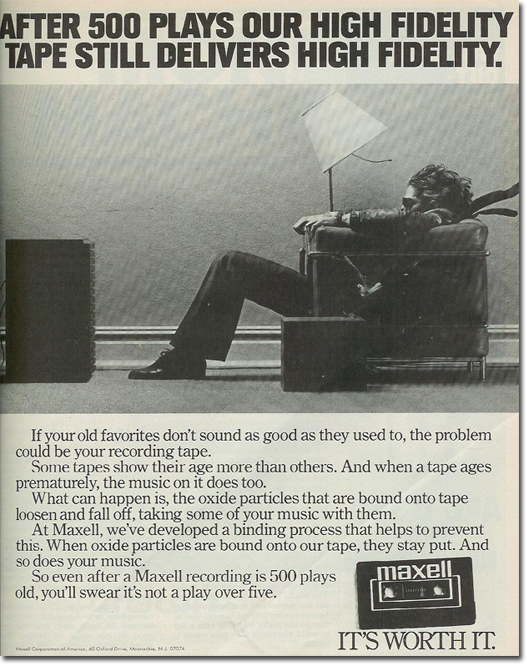
Although in this case the phonograph horn is used for recording, this photo's nonetheless an interesting visual precursor to the famous Maxell tape ad. Meanwhile, Wikipedia says that the Piegan Blackfeet these days live mostly on the larger Blackfeet Nation in northwestern Montana.
Nate
:
photo from wikipedia :: via Next Nature
As part of a recent twelve-year restoration of the 16th century cathedral in 's-Hertogenbosch in the Netherlands, the Dutch sculptor Ton Mooy was commissioned to create 25 new statues of angels to be added to the outside, including one of a jeans-wearing angel utilizing a thoroughly modern bit of technology. "'The phone has just one button,' says the artist. 'It dials directly to God.'" Make of it what you will.
Nate:
Like earthquakes, revolutions are much better at destroying than building. There is an important asymmetry here, whose roots go all the way down to the laws of physics: It is possible to change things quickly for the worse. It only took two hours after the collision between a 767 and the South Tower of the World Trade Center to destroy it. But no one can build the World Trade Center in two hours. The only thing you can do with Rome in a day is burn it.
—Culture Making, p.58
excerpt Sublime technologies
Sublime technologies
I agree, but I also protest: Henry Adams' awe at seeing a 40-foot dynamo attractively displayed at the 1900 Paris Exhibition is one thing, but my guess is that an early-20th-century worker-with-dynamos might have eventually found them boring, utilitarian, only worthy of special emotion when they malfunctioned. And is awe of machines truly absent when Apple can call a new product "magical and revolutionary" and one can make a reasonably intelligent case that it might be? For my part, I do feel wonder along with fear and trembling on occasion over the mysteries of email, say nothing of free Skype conferences with friends in Africa, or the reasonable expectation that I can now find out most things I want to know nearly instantaneously.
Nate:
In the early age of machines, they inspired awe by proving capable of doing what man could never do alone (such as power an entire factory), or what we once believed only man could do (play chess). Now we expect our machines to do just about everything for us, from organizing our finances to writing our grocery lists. Our machines not only ease the mundane burdens of daily life (cooking, cleaning, working), but also serve, increasingly, as both our primary source of entertainment and the means for maintaining intimate relationships with others. Henry Adams’s dynamo has been replaced by Everyman’s iPod, and awe has given way to complacence and dependence. Your computer’s e-mail program doesn’t inspire awe; it is more like a dishwasher than a dynamo. Nineteenth-century rhapsodies to the machines that tamed nature, such as the steam engine, have given way to impatience with the machines that don’t immediately indulge our whims.
excerpt Marginalia
Marginalia
This year I've joined a reading group at my church; last Sunday the book was an old collection of Wendell Berry's influential agrarian essays. My eleven-year-old nephew sat in on our discussion (he'd read a couple of the essays in preparation), and asked a question that gets to the well-worn stumbling block when it comes to Berry's bracing jeremiads: "But what if I want to be a computer programmer and not a farmer?" There are ways of answering that within the text, but not always satisfyingly. For me, the passage I loved most from the book was this one, the grace-note ending to Berry's essay on wilderness.
Nate:
Looking at the monocultures of industrial civilization, we yearn with a kind of homesickness for the humanness and the naturalness of a highly diversified, multipurpose landscape, democratically divided, with many margins. The margins are of the utmost importance. They are the divisions between holdings, as well as between kinds of work and kinds of land. These margins—lanes, streamsides, wooded fencerows, and the like—are always freeholds of wildness, where limits are set on human intention. Such places are hospitable to the wild lives of plants and animals and the wild play of human children. They enact, within the bounds of human domesticity itself, a human courtesy towards the world that is one of the best safeguards of designated tracts of true wilderness.
video  Medieval helpdesk
Medieval helpdesk
"Medieval helpdesk," from the show Øystein og jeg, Norwegian Broadcasting (NRK), 2001 :: via languagehat
You put your cultural product out there, but it's still up to individual people (and their oft long-suffering helpers) to let it succeed or fail. I love that this sketch is from a decade ago but feels perfect for the current tech-nerd-philosophical debates about the iPad, the Kindle, and the future of the book.
Nate:
excerpt Robots and the grace of presence
Robots and the grace of presence
Humanoid robots often look creepy, but in person the uncanniness quickly fades and—in admittedly weird human-to-machine way—offers an opening for grace: "in person, most robots, particularly ones designed to interact with humans, are simply not scary. They're bumbling and a little helpless. Like a pet or a child, you cut them slack."
Nate:
According to all of the roboticists and computer scientists we interviewed, the uncanny is in short supply during face-to-face contact with robots. Two of the robots that inspire the most terror—and accompanying YouTube comments—are Osaka University’s CB2, a child-like, gray-skinned robot, and KOBIAN, Waseda University’s hyper-expressive humanoid. In person, no one rejected the robots. No one screamed and threw chairs at them, or smiled politely and slipped out to report lingering feelings of abject horror. In one case, a local Japanese newspaper tried to force the issue, bringing a group of seniors to visit the full-lipped, almost impossibly creepy-looking KOBIAN. One senior nearly cried, claiming that she felt like the robot truly understood her. A previously skeptical journalist wound up smiling and cuddling with the ominous little CB2. The only exception was a princess from Thailand, who couldn’t quite bring herself to help CB2 to its robotic feet.
Royalty notwithstanding, the uncanny effect appears to be an incredibly specific and specialized phenomenon: It seems to happen, when it does, remotely. In person, the uncanny vanishes. There’s nothing in the way of peer-reviewed evidence to support this, but then, there’s almost nothing to confirm the uncanny effect’s existence in the first place. As an unsupported theory that has morphed into a nerdy breed of urban legend, anecdotes are all we have to work with.
excerpt The sparrow and the phonograph
The sparrow and the phonograph
It was hard to decide which part of this article to excerpt: the hilarious bombast of the opening or the all-too-prescient middle sections about the waning of everyday amateur musicianship in an age of recorded performance: "And what is the result? The child becomes indifferent to practice, for when music can be heard in the homes without the labor of study and close application, and without the slow process of acquiring a technic, it will be simply a question of time when the amateur disappears entirely, and with him a host of vocal and instrumental teachers, who will be without field or calling." Nah, I'll go with the opening. This is, after all, the guy whose fortunes rose on mass-music-publishing, who recoiled and reinvented the tuba so that you could march with it.
Nate:
Sweeping across the country with the speed of a transient fashion in slang or Panama hats, political war cries or popular novels, comes now the mechanical device to sing for us a song or play for us a piano, in substitute for human skill, intelligence, and soul. Only by harking back to the day of the roller skate or the bicycle craze, when sports of admitted utility ran to extravagance and virtual madness, can we find a parallel to the way in which these ingenious instruments have invaded every community in the land. And if we turn from this comparison in pure mechanics to another which may fairly claim a similar proportion of music in its soul, we may observe the English sparrow, which, introduced and welcomed in all innocence, lost no time in multiplying itself to the dignity of a pest, to the destruction of numberless native song birds, and the invariable regret of those who did not stop to think in time.
On a matter upon which I feel so deeply, and which I consider so far-reaching, I am quite willing to be reckoned an alarmist, admittedly swayed in part by personal interest, as well as by the impending harm to American musical art. I foresee a marked deterioration in American music and musical taste, an interruption in the musical development of the country, and a host of other injuries to music in its artistic manifestations, by virtue—or rather by vice—of the multiplication of the various music-reproducing machines.
excerpt What a difference a TV makes
What a difference a TV makes
Introducing television to an area can shift the horizons of the possible radically and quickly, especially for women. It's worth noting that both the positive and negative consequences recorded in this study were by and large unintended and unforeseen.
Nate:
Cable and satellite television may be having an even bigger impact on fertility in rural India. As in Brazil, popular programming there includes soaps that focus on urban life. Many women on these serials work outside the home, run businesses, and control money. In addition, soap characters are typically well-educated and have few children. And they prove to be extraordinarily powerful role models: Simply giving a village access to cable TV, research by scholars Robert Jensen and Emily Oster has found, has the same effect on fertility rates as increasing by five years the length of time girls stay in school.
The soaps in Brazil and India provided images of women who were empowered to make decisions affecting not only childbirth, but a range of household activities. The introduction of cable or satellite services in a village, Jensen and Oster found, goes along with higher girls’ school enrollment rates and increased female autonomy. Within two years of getting cable or satellite, between 45 and 70 percent of the difference between urban and rural areas on these measures disappears. In Brazil, it wasn’t just birthrates that changed as Globo’s signal spread—divorce rates went up, too.
excerpt Consuming like it’s 2007
Consuming like it’s 2007
Committing to consuming only two-year-old media on two-year-old tech has an advantage beyond reduced prices: I'm guessing there would be a quite helpful filtering effect. A discipline of consuming the not-so-new is still, of course, a discipline of consumption—probably not the best thing to order all one's cultural interactions around.
Nate:
It seems to me that the best way to instantly raise your standard of living is to live in the past. If you subsist entirely on two-year-old entertainment, and the corresponding two-year-old technology used to power it, you’re cutting your fun budget in half, freeing up that money for more exciting expenditures like parking meters and postage.
The problem is that it’s hard living out of sync with the world around you. Just ask the Amish or Bill Cosby.
excerpt Written as they should be
Written as they should be
Here's the best thing about this excerpt: when you click through to the Eco's original article, right now you get this message: "This article has been removed due to web rights expiry." Frail letters indeed! But let's return to penmanship: I'm reminded of this recent New York Times Op-Art piece, a spirited call to supplant the old-style loopiness of the Palmer method of handwriting instruction with a more-legible italic script. Sounds tempting ...
Nate:
My parents’ handwriting was slightly slanted because they held the sheet at an angle, and their letters were, at least by today’s standards, minor works of art. At the time, some – probably those with poor hand- writing – said that fine writing was the art of fools. It’s obvious that fine handwriting does not necessarily mean fine intelligence. But it was pleasing to read notes or documents written as they should be. My generation was schooled in good handwriting, and we spent the first months of elementary school learning to make the strokes of letters. The exercise was later held to be obtuse and repressive but it taught us to keep our wrists steady as we used our pens to form letters rounded and plump on one side and finely drawn on the other. Well, not always – because the inkwells, with which we soiled our desks, notebooks, fingers and clothing, would often produce a foul sludge that stuck to the pen and took 10 minutes of mucky contortions to clean.
image  How jobs stack up
How jobs stack up

from Job Voyager, a sample application powered by the Flare open-source data visualization toolkit :: via GOOD
Click through on the image for this great interactive chart from 1850–2000, showing the various professions people with jobs reported to the US Census—blue layer s for men and red/pink for women. It seems quite obvious that being an actual full-time homemaker never made the chart (and the scarcity of female farmers suggests that wives' (and daughters') contributions to running the farm didn't register. I'm also fascinated by the drop in farmers (and increase in farm laborers) between 1860 and 1870. I'm guessing the Civil War had something to do with it, but I'm not quite sure what.
Nate:
repost  Multi-touching
Multi-touching
I wound up on this product's page in the iPhone App Store on a whim—wanting to see what exactly a $149.99 application was doing in a 99-cent ecosystem. I delved into the customer reviews (one of the rising literary forms of our era) and realized that: a) nearly every reviewer was giving the product five stars; b) nobody was mentioning the price except to say how cheap it was, and c) this may have been the first and only time the App Store has made me want to smile and to cry at the same time.
Nate: 

????? My daughter is 23 and has been using augmentative communication devices since she was a little girl. We have used devices from several different companies, so we are pretty experienced. This is, by far, the easiest to program. There are lots of preprogrammed categories, so it is possible to start communicating right away, without doing anything other than downloading it. ... After years of dragging around a 4–7 pound communication device that looks sort of ‘clinical’, it’s really cool to have a small iPod touch and a speaker (all of 15 ounces!) to bring with us. ... My daughter has enough things to separate her from her peers. It’s nice to have something for a change that’s the same as other people are using. Can’t say enough good about it!!!
excerpt Perils of a great preformance
Perils of a great preformance
We count on our greatest artists to open up the horizons of the possible, showing us what we didn't know could be done. But in the realm of operatic improvisation, a great artist (in conjunction with game-changing technology), has apparently severely reduced the horizons of the possible, or at least of the desirable.
Nate:

The conductor Will Crutchfield, who specializes in bel-canto opera and doubles as a musicological detective, recently sat down to compare all extant recordings of “Una furtiva lagrima,” the plaintive tenor aria from Donizetti’s “L’Elisir d’Amore.” Crutchfield wanted to know what singers of various eras have done with the cadenza—the passage at the end of the aria where the orchestra halts and the tenor engages in graceful acrobatics. Donizetti included a cadenza in his score, and later supplied two alternative versions. Early recordings show singers trying out a range of possibilities, some contemplative, some florid, none the same. Then came Enrico Caruso. He first recorded “Una furtiva lagrima” in 1902, and returned to it three more times in the course of his epochal studio career. After that, tenors began replicating the stylish little display that Caruso devised: a quick up-and-down run followed by two slow, sighing phrases. Out of more than two hundred singers who have recorded the aria since Caruso’s death, how many try something different? Crutchfield counts four.
excerpt To see takes time
To see takes time
Further thoughts and insights on the effects of new technology, particularly Twitter and texting, from cultural commentator Michael Metzger of The Clapham Institute.
Christy:
Twitter has been described as perhaps one of the greatest technological innovations since the telegraph. It will better connect us. Perhaps. But what will it undo?
Benedictine monks invented the mechanical clock in the 12th century to remind workers to take periodic Sabbath breaks. They never imagined someone like Frederick Taylor, known as the Father of Scientific Management, would use clocks to time workers in order to increase productivity.
William Farish (a Cambridge University tutor) never imagined his idea of numerical grading—unheard of before his time—would eventually marginalize mentoring. Before 1792, students were evaluated through dialogue, not digits. This conversation required a tutor. Numerical grading has wiped out mentoring.
Now consider Twitter—a wonderful new technology promising us the world. It can do a lot. What might it undo? How about paying attention?
excerpt On a human plane
On a human plane
A Spanish novelist's prescription for his fear of flying: learn to love airplanes as individuals. The humanizing touch is hardly absent from the history of flight: think of Howard Hawks' classic film Only Angels Have Wings or all those pin-up models painted onto the noses of WWII bombers. And it lives on in the work of a few contemporary writers—William Langewiesche in particular—even in the serial-number world of today's commercial aviation.
Nate:
We live in an age that tends to depersonalize even people and is, in principle, averse to anthropomorphism. Indeed, such a tendency is often criticized, erroneously and foolishly in my view, since that ‘rapprochement’ between the human and the non-human is quite natural and spontaneous, and far from being an attempt to deprive animals, plants and objects of their respective selves, it places them in the category of the ‘humanizable’, which is, for us, the highest and most respectable of categories.
I know people who talk to, question, spoil, threaten or even quarrel with their computers, saying things like: ‘Right now, you behave yourself,’ or thanking them for their help. There’s nothing wrong with that, it’s perfectly understandable. In fact, given how often we travel in planes, the odd thing about our relationship with them – those complex machines endowed with movement to which we surrender ourselves and that transport us through the air – is that it isn’t more ‘personal’, or more ‘animal’, or more ‘sailor-like’, if you prefer. Perhaps those who crew them haven’t known how to communicate this to us. I’ve never seen them pat a plane, as you might pat a horse to calm or reward it; I’ve never seen planes being groomed and cleaned and tidied, except very hurriedly and impatiently; I’ve never seen them loved as Conrad’s captain loved his sunken brig; I’ve never seen air hostesses – who spend a lot of time on-board – treat them with the respect and care, at once fatherly and comradely, enjoyed by ships.
video Les was More
Les was More
"Les Paul & Mary Ford on Alistair Cooke's 'Omnibus,'" 23 October 1953 :: via Boing Boing
Last week guitar and recording pioneer Les Paul passed away at age 94. While I knew he'd had something to do (in parallel with Leo Fender and Adolph Rickenbacker) with the development of the solid-body electric guitar, I didn't realize that he had a still-more-solid claim as the father of multitrack recording. If the solid body made the rock-n-roll (and modern country) "sound" possible, multitrack recording has fundamentally changed the way music is produced—vastly expanding the sonic and harmonic possibilities, but also undermining live performance as the preferred way of experiencing music. Legacy aside, though, it's charming seeing Les and his wife Mary Ford showing off their magical musical tools on this 1950s variety show.
Nate: