Posts tagged primordial stories
 Evolution’s partial story

In the story of evolution as we know it, there is no Eden. The world was never peaceful and perfect, free from death and pain. Rather the upward curve has been constant and gradual, always accompanied by death, which culls those creatures less than fit for survival.
Nor does evolution tell a story of Adam and Eve. The human race also has risen incrementally. Evolution suggests no story of atonement, for it knows nothing of personal responsibility, law, sin, shame or redemption.
The absence of such information in the story of evolution does not suggest to me, as it does to Haught, that we must throw out large parts of the Bible’s story. One learns different things from different sources—some things from science, some things from music, some things from the Bible. On purely empirical grounds, I would insist that sin is as reliable a fact as can be, even if evolution knows nothing of it. The same with beauty and truth and love—equally missing from evolution as Darwin traces it. Evolution knows of populations, not individuals. It could never chastise Cain for killing his brother. Murder is part of evolution’s mechanism of change. It would be a good thing, if evolution knew anything about “good.”
“Good” is not part of evolution’s story. Nevertheless good exists.
Even better than it appears

“Out of the ground the Lord God made to grow every tree that is pleasant to the sight and good for food” (Gen. 3:9). This garden, this original gift of culture, is not just a utilitarian source of nourishment. It is not just a vegetable garden, populated with a healthful array of plants that will provide the Creator’s RDA of nutrients to the dutiful fruit- and vegetable-eating human gardener. It is also a place of beauty. The trees of the garden are not just good for something. They are good simply in the beholding. They are beautiful.
But even more striking than the description of the vegetation is the least remarked-upon part of the whole story in Genesis 2. “The name of the first [river] is Pishon; it is the one that flows around the whole land of Havilah, where there is gold; and the gold of that land is good; bdellium and onyx stone are there” (v. 12).
Why does the author indulge in this metallurgical excursion—with its digression within an excursion, “And the gold of that land is good”? Is this a treasure map for future readers? What is the point of this list of precious natural resources? Note that these are not primarily useful minerals or substances. The text does not say that the land of Havilah has good iron, granite, and bauxite. These are substances whose only real value is in their beauty. God has located the garden in a place where the natural explorations of its human cultivators will bring them into contact with substances that will invite the creation of beauty.
I owe to Makoto Fujimura the further observation that these substances are hidden. They are not like the low-hanging fruit of the garden’s trees. They are latent—lying below the surface of the very good world. Only by exploration and excavation will they be discovered. Only by experimentation and craftsmanship will their possibilities be disclosed. God has placed primordial humanity in a world that will only reach its full potential for beauty when it is cultivated, explored—where more goodness waits to be unearthed. The world is even better than it appears. The gold of that land is good.
In the beginning was the story
“Mistake me not,” said the Cardinal, “the literature of which we are speaking—the literature of individuals, if we may call it so—is a noble art, a great, earnest and ambitious human product. But it is a human product. The divine art is the story. In the beginning was the story. At the end we shall be privileged to view, and review, it—and that is what is named the day of judgment.
“But you will remember,” he remarked, as in a parenthesis and with a smile, “that the human characters in the book do come forth on the sixth day only—by that time they were bound to come, for where the story is, the characters will gather!”
Painting with Adam’s palette
When Adam gardened, he imitated his Maker in a purely recreative act of cultivation and care. He did not need to subdue the earth in order for it to yield fruit. Rather, the plants were Adam’s palette, and the earth was his canvas. There was nothing but delight in the Garden, for Eden itself means “garden of delight.” When I dug my garden in Culpeper, I was preparing a canvas. And when I arranged the flowering plants and shrubs on the freshly turned ground, I saw already the pink peony blossoms with their heads turned down toward the blue iris, and the white phlox standing straight beside the slouching crimson bee balm. I breathed in the sweet honeysuckle and the citrus-scented bergamot.
I have said on occasion that I think gardening is nearer to godliness than theology. (By “theology” I mean the kind of formal written discourse that my special guild of academic theologians does, not the praise of God and communion with divine life that ought to inspire theology at its core.) True gardeners are both iconographers and theologians insofar as these activities are the fruit of prayer “without ceasing” (1 Thess. 5:17, NKJV). Likewise, true gardeners never cease to garden, not even in their sleep, because gardening is not just something they do. It is how they live.
Largely a matter of distance
Nate
:In the heart of the big myths is the dark passage, the Night Sea Journey; it contains the most ominous and mysterious places through which the hero must pass before the quest, whatever it is, can be fulfilled. One thinks of Dante going down, layer after fantastical layer, or of Odysseus, his ship sunk, swimming alone to Phaeacia, or even of the Ugly Duckling struggling through his long and awful winter. In one of our oldest stories, the legend of Gilgamesh, the great king—Gilgamesh—loses his friend in death. This throws him into angst about his own mortality, so he goes to seek a workaround in the faraway land of the divine. As part of his dark journey, Gilgamesh must run through a tunnel under the earth, the very tunnel the sun uses on its return from west to east. He must clear the tunnel before the sun heaves through—and (I spill the beans) he does so without incident. Yet among the many Night Sea images, I find this small passage particularly haunting: the image of one man running for hours in cindered darkness, watching for the first light of another world while at the same time listening for the ominous rumbling of a star. In the old writings of the sublime and the beautiful, there’s the observation that the difference between beauty and terror is largely a matter of distance. A single star on the horizon awakens a poignant joy, but much closer to its fires, the earlier joy grades quickly into a feeling more edgy and raw.
Architecture as anthill madness
Nate
:
The Tower of Babel is a vision of architecture as anthill madness. As the British Museum’s exhibition Babylon: Myth and Reality reveals, Brueghel is not the only artist driven to imagine this fabulous building. Towers of Babel proliferate in this show, be they painted with miniaturist precision or exploding in apocalyptic doom; there’s even one made of shoes, in a 2001 painting by Michael Lassel. Martin van Heemskerk’s, however, is square, in keeping with old sources he studied, but his attempt to visualise what the tower was “really” like does not stop him showing its top smashed apart by divine lightning. In an anonymous Dutch painting—one of a series that riff on Brueghel—the city that surrounds the tower is on fire, the summit of the hubristic edifice menaced by an eerie light coming through the storm clouds. Perhaps the strangest is by Athanasius Kircher, a 17th-century scholar whose light, airy spiral looks prophetically modern, like a blueprint for a skyscraper.
Nate
:I feel sometimes as if I were a child who opens its eyes on the world once and sees amazing things it will never know any names for and then has to close its eyes again. I know this is all mere apparition compared to what awaits us, but it is only lovelier for that. There is a human beauty to it. And I can’t believe that, when we have all been changed and put on incorruptibility, we will forget our fantastic condition of mortality and impermanence, the great bright dream of procreating and perishing that meant the whole world to us. In eternity this world will be Troy, I believe, and all that has passed here will be the epic of the universe, the ballad they sing in the streets. Because I don’t imagine any reality putting this one in the shade entirely, and I think piety forbids me to try.
 Visualizing the Bible

Nate
:
 The sedate solar system
Andy
:
Historically, humans have often felt the need to be special, and just as often have been disappointed. The Earth, as it turned out, wasn’t at the center of the universe. Humans are smart, but in the end, they evolve, live and die just like all the other living things on the planet. In astronomy, the prevailing theoretical models of how the solar system got here have assume that, based on past experience, we’re probably just an average solar system.
But according to a new study by Northwestern University astronomers looking at 300 planets orbiting other stars, we might really be special. “We now know that these other planetary systems don’t look like [our] solar system at all,” said Frederic Rasio, an astronomer at Northwestern, in Chicago. Computer simulations used by Rasio’s team showed that the birth of a planetary system is a very violent affair, with the gas disk that gives birth to the planets pushing them toward the central star, where they often crowd together to be engulfed. Gravitational encounters between growing planets fling some across the planetary system, or into deep space. “Such a turbulent history would seem to leave little room for the sedate solar system, and our simulations show exactly that,” said Rasio in a news release from Northwestern University. Our solar system “had to be born under just the right conditions to become the quiet place we see,” he said. “The vast majority of other planetary systems didn’t have these special properties at birth and became something very different.”
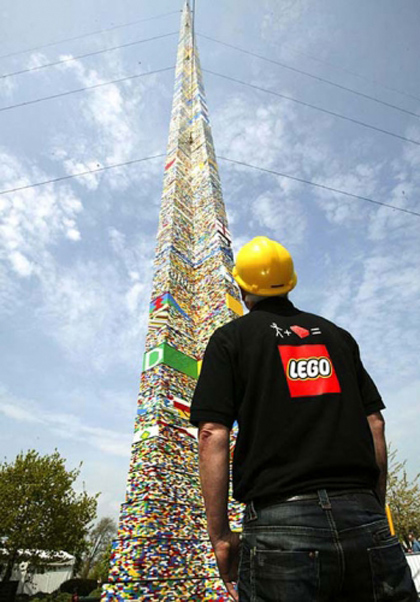
 Tower of Lego Babel
Nate
:You can call me Al
Nate
:The change in the way these children address their parents probably stems from baby boomers’ less authoritarian child-raising practices. Technology is a factor, too, given the offhand style that people use in instant messages and cellphone texts. The Internet has made people comfortable using names that are not their own - in particular, the frequent use of screen names online has made naming a bit more elastic, said Cleveland Evans, a psychology professor at Bellevue University in Nebraska who is a former president of the American Name Society, a group that studies the cultural significance of names. Screen names, he said, “might have made people freer to think of the same person addressed by multiple names, and that’s what nicknaming is.”