Posts tagged poverty
 Paving the home

Starting in 2000, a program in Mexico’s Coahuila state called “Piso Firme” (Firm Floor) offered up to $150 per home in mixed concrete, delivered directly to families who used it to cover their dirt floors. Scholar Paul Gertler evaluated the impact: Kids in houses that moved from all-dirt to all-concrete floors saw parasitic infestation rates drop 78 percent; the number of children who had diarrhea in any given month dropped by half; anemia fell more than four-fifths; and scores on cognitive tests went up by more than a third. (Perhaps unsurprisingly, mothers in newly cemented houses reported less depression and greater life satisfaction.) By 2005, Piso Firme had spread to other states, and 300,000 households—about 10 percent of dirt-floor houses in Mexico—had taken part in the program.
It helps if the street outside the house gets paved, too—not so much for health reasons as for economic ones. Economists Marco Gonzalez-Navarro and Climent Quintana-Domeque found in a 2010 study that paving the street in the town of Acayucan, Mexico, added more than 50 percent to land values and caused a 31 percent rise in rental values. It also considerably increased households’ access to credit. As a result, households on paved streets were 40 percent more likely to have cars.

Bauleni Banda, sustenance maize farmer, Chikandwe, Malawi
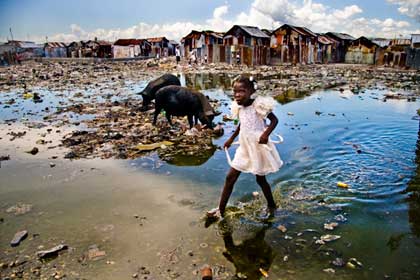
The truth is that the development sector, just like any other business, needs revenue to survive. Too frequently, this quest for funding uses these kind of dehumanizing images to draw pity, charity, and eventually donations from a largely unsuspecting public. I found it outrageous that such an incomplete and often inaccurate story was being so widely perpetuated by the organizations on the ground – the very ones with the ability and the responsibility to communicate the realities of rural Africa accurately.
This is not to say that people do not struggle, far from it, but the photos I was seeing only told part of the story. I thought that these images were robbing people of their dignity, and I felt that the rest of the story should be told as well. Out of this came the idea for a photography project, which I am tentatively calling “Perspectives of Poverty”. I am taking two photos of the same person; one photo with the typical symbols of poverty (dejected look, ripped clothes, etc.), and another of this person looking their very finest, to show how an image can be carefully constructed to present the same person in very different ways. I want to bring to light some of the different assumptions we make about a person, especially when we see an image of “poverty” from rural Africa.

 Giving during disasters

My preference in giving is not to give quickly nor in times of disaster. There are plenty of people doing that and you don’t have to join the bandwagon. So stop feeling guilty and don’t give to get that monkey off your back. Instead, carefully investigate options and choose to make a longer-term, more strategic decision to truly partner with an organization.
Some have asked me who they should consider giving to following the Haiti earthquake. If you want to provide immediate assistance, send your funding through large corporate charities that had a well-established presence on the ground for years prior to the quake. I specifically recommend World Vision Canada with whom we’ve had a long term successful partnership. Their reputation speaks for itself. They specialize in disaster relief and their logistical ability to respond effectively is unequaled. CEO Dave Toycen is on the ground there now, and is tweeting his thoughts at @toycenontheroad. You can know that even though your immediate funding can be used for an urgent disaster, that WV will be present in Haiti for the long term. Poverty isn’t solved in a week.
For those who prefer a smaller, grassroots response my choice would be Haiti Partners. They have a significant history as a Florida-based charity focused on building schools and training teachers as a long term investment in the next generation of Haitians. They aren’t new to Haiti like some other agencies seeking funding for the Haiti quake. They speak Creole, their staff are Haitians. They’re now expanding their support base to offer Canadian donors an ability to partner with them. In fact, for months they’ve been planning that Sunday, January 24 would be the launch of their first Canadian fundraiser in Toronto.
You can follow co-director John Engle at twitter (@haitipartners) as well as their blog or YouTube with frequent, informative video updates.
 A tale of two cities
What if honesty reduces funding?
A tale of two cities
What if honesty reduces funding?
n Kiva’s defense, its behavior is emblematic of fund-raising in microfinance and charity generally, and is ultimately traceable to human foibles. People donate in part because it makes them feel good. Giving the beneficiary a face and constructing a story for her in which the donor helps write the next chapter opens purses.
Our sensitivity to stories and faces distorts how we give, thus what charities do and how they sell themselves. What if the best way to help in some places is to support communities rather than individuals? To make roads rather than make loans? To contribute to a disaster preparedness fund rather than just respond to the latest earthquake? And how far should nonprofits go in misrepresenting what they do in order to fund it? It is not an easy question: what if honesty reduces funding?
The big lesson is that the charities we observe, the ones whose pitches reach our retinas, are survivors of a Darwinian selection process driven by our own minds. An actual eBay venture called MicroPlace competes with Kiva; but MicroPlace is more up-front about the real deal. Its page for sample borrower Filadelfo Sotelo invites you to “invest in the organization that helped Filadelfo Sotelo: Fondo de Desarrollo Local” (FDL). This honesty is probably one reason MicroPlace has badly lagged Kiva. Who wants to click on the FDL icon when you can click on a human face?

 The power of weakness
Anybody who has experienced fatherhood or motherhood knows about the power of the infants. The arrival of a baby completely changes the structure and life of the whole family. One could say actually that the infant is the one who has the authority. The activities of the whole family are ordered to his needs. What is true for infants is also true for sick, handicapped and aged people. As I have argued above, they have a real power of reorganization of the human communities. But I believe that the experience repeatedly made by humans is that there is something beyond. Entering into relation with the weak may become an experience of discovery and acceptation of our own weaknesses. Discovering indeed that whenever I recognize that I am weak, then I am strong. And entering through this experience into a world of fragility and vulnerability that we share with our friends who have made the same experience, a world that becomes a world of kindness, mercy and love.
What the poor see
There is no end to the desire for wealth. Recently, I asked an entrepreneur, whose net worth is in the nine figures, if he thought greed or pride was a greater problem. He said greed has no end and that he knows people who are unhappy with their private Gulfstream jet because they have friends whose jets are slightly better. . . .
I once visited a microfinance loan group in Manila. These people were poor. We were in a one-room house. It was raining and water was pouring down the wall and flowing across the floor. At the end of the meeting, they took up an offering for “the poor in their community.” The total was $2.80. They made a vat of porridge, took it to the center of the slum and within minutes children were emerging to eat. Several were obviously malnourished.
We are in a global economic crisis because of this: The rich see the very rich and want to live like them. The poor see the very poor and want to help them.
Slums are the answer
Nate
:To be sure, there is something unseemly in privileged people rhapsodizing about such places. Prince Charles, for all his praise, does not appear poised to move to a shack in Dharavi. Identifying the positive aspects of poverty risks glorifying it or rationalizing it. Moreover, some of the qualities extolled by analysts are direct results of deprivation. Low resource consumption may be good for the earth, but it is not the residents’ choice. Most proponents of this thinking agree that it’s crucial to address the conflict between improving standards of living and preserving the benefits of shantytowns.
But given the reality that poverty exists and seems unlikely to disappear soon, squatter cities can also be seen as a remarkably successful response to adversity - more successful, in fact, than the alternatives governments have tried to devise over the years. They also represent the future. An estimated 1 billion people now live in them, a number that is projected to double by 2030. The global urban population recently exceeded the rural for the first time, and the majority of that growth has occurred in slums. According to Stewart Brand, founder of the Long Now Foundation and author of the forthcoming book “Whole Earth Discipline,” which covers these issues, “It’s a clear-eyed, direct view we’re calling for - neither romanticizing squatter cities or regarding them as a pestilence. These things are more solution than problem.”


Nate
:Making wonderful curves
Nate
:
Twenty years later, this area is still poor, with high unemployment but hope can be found at the Village of Arts and Humanities. That’s what the small art park has grown into—a tangible symbol of renewal that covers more than 120 formerly abandoned lots with murals, sculpture gardens, mosaics, flowers, community gardens, playgrounds, performance spaces, basketball courts, art studios, even a tree farm.
“The entire community seems to take part in the use of the spaces,” writes Kathleen McCarthy, who nominated the Village for Project for Public Space’s authoritative list of the world’s Great Public Spaces. “As we walked down the street, trying to find one of the parks, a man walking beside us directed us to the Park, and told us the history of it and the wonderful artist, Lily Yeh who started the park. He spoke with pride that this was a part of his community. We sat on the benches made of smashed tile and mirror, making wonderful curves and places to sit. Across from us, women sat and smiled, waved. Children ran over and asked us to hide them during a game of hide-and-seek…. I’ve never felt more welcomed in an unfamiliar place.”
Nate
:Food stamps and farmers markets
Nate
:
In the 2008 farm bill, Congress allocated $20 million for a pilot program to explore how to create incentives to purchase fruits, vegetables or other healthful foods in order to improve the diets of food stamp recipients and potentially reduce obesity. Several nonprofit groups and foundations are experimenting with similar incentives.
One is the Wholesome Wave Foundation, an organization that works to make locally grown food more widely available. In the spring, it launched a program that doubles the value of food stamps and fruit and vegetable vouchers of low-income mothers and seniors who use them at farmers markets in Connecticut, Massachusetts and California.The Wholesome Wave matching grants were an instant hit at the City Heights market in San Diego. On the first day that matching funds became available, sales using government-issued electronic benefit cards soared by more than 200 percent. In subsequent weeks, the line to receive matching vouchers formed at 7:30 a.m., and the available funds were exhausted by 9:30 a.m., just 30 minutes after the market opened.
“We’re not taking away your benefits because you spend them on Twinkies,” said Michel Nischan, a Connecticut chef and president of Wholesome Wave. “But if you decide you want to spend it on fresh tomatoes, you’ll get double your money.”
Glasses for the masses
Nate
:
Some 30,000 pairs of his spectacles have already been distributed in 15 countries, but to Silver that is very small beer. Within the next year the now-retired professor and his team plan to launch a trial in India which will, they hope, distribute 1 million pairs of glasses. The target, within a few years, is 100 million pairs annually. With the global need for basic sight-correction, by his own detailed research, estimated at more than half the world’s population, Silver sees no reason to stop at a billion.
If the scale of his ambition is dazzling, at the heart of his plan is an invention which is engagingly simple. Silver has devised a pair of glasses which rely on the principle that the fatter a lens the more powerful it becomes. Inside the device’s tough plastic lenses are two clear circular sacs filled with fluid, each of which is connected to a small syringe attached to either arm of the spectacles.
The wearer adjusts a dial on the syringe to add or reduce amount of fluid in the membrane, thus changing the power of the lens. When the wearer is happy with the strength of each lens the membrane is sealed by twisting a small screw, and the syringes removed. The principle is so simple, the team has discovered, that with very little guidance people are perfectly capable of creating glasses to their own prescription.
Baby on board
Nate
:
In truth, experts say, the developing world doesn’t need more incubators. It needs incubators that work. Over the years, thousands have been donated from rich nations, only to end up in “incubator graveyards” — most broken, some never opened. According to a 2007 study from Duke University, 96 percent of foreign-donated medical equipment fails within five years of donation — mostly because of electrical problems, like voltage surges or brownouts or broken knobs, or because of training problems, like neglecting to send user manuals along with the devices.
To compensate for this philanthropic shortsightedness, medical staffs either crank up the temperature in “incubator rooms” to 100 degrees or more, or swaddle babies in plastic to hold in body heat. Such makeshift solutions led the Boston team to ask: How can we make an incubator for the developing world that will get fixed? . . .
In his discussions with doctors who practice in impoverished settings, Dr. Rosen learned that no matter how remote the locale, there always seemed to be a Toyota 4Runner in working order. It was his “Aha!” moment, he recalled later: Why not make the incubator out of new or used car parts, and teach local auto mechanics to be medical technologists?
Getting beyond “I don’t know”
Nate
:This organization, and this sanitary pads project, comes as a result of many years of working with girls in Kenya, seeing problems, and searching for solutions. And it comes from living in Kenya for more than seven years now, and revising the way I see the world in light of new information and new experiences.
When I worked for five years with former street children, our organization’s biggest costs per child were bread and sanitary pads. I realized this was a national problem, that girls across the country went through horrible things during their periods.
This to me was a question of social justice. The poverty that mires 64% of Kenyans is unjust. To allow girls and their future families to sink further into poverty because they lack the funds necessary to stem the flow of their monthly menstruation and sit out of school four days a month—I cannot be the person who knows but remains on the sidelines. I believe the words of my high school mentor, Denise Fuller, who said, “the easiest words for someone to say are ‘I don’t know’. Because, once we know, we are required to do something.”
Rice husk power
Nate
:NextBillion.net: Tell me about rice husk – what is it, how much is there, where do you find them? What do farmers do with them now?
Chip Ransler: Rice husk is the outside of a rice kernel. When you harvest rice, husk represents about 30 percent of the gross weight. As a result, husks are removed and discarded before transport. In a typical village, about 1500 tons of rice are harvested every season, yielding 500 tons of husk and 1000 tons of edible product. The farmers either burn the husk or allow it to rot in the fields.
Rice husk is cellulosic, which means it can be heated up and released for energy – the gas released is similar to methane. It also contains silica, which is released as a waste product when burned.
So, why is this interesting? If you took a map of the world’s energy poor areas and compare it to a map of rice producing areas, these two maps would look nearly identical. So we use husk to make electricity. The gas we make out of the husk is filtered, then run through a diesel-like engine to generate power.
Like I said, farmers throw away or burn rice husk – releasing methane into the atmosphere. This is an opportunity too. We’re working with the Indian government on getting our Clean Development Mechanism certification to sell carbon credits associated with our plants. And the silica – which is the other waste product – is sold to concrete manufacturers. So we take agricultural waste and turn it into electricity, minerals and carbon credits.
The places we live
Nate
:One billion people live in slums. Their numbers are supposed to double over the next quarter-century. So: Who are those people — and what must their lives be like?
The Norwegian photojournalist Jonas Bendiksen has spent a good deal of time in Indian, Kenyan, Indonesian, and Venezuelan slums, and his website, The Places We Live, features dazzling 360-degree photos of homes and shanties, navigable and altogether immersive, along with audio recordings made by the inhabitants. Prepare yourself to gape, gasp, laugh, cry, and experience every emotion in between: In Mumbai, you’ll meet the Shilpiri family (15 people crammed into a tiny space through which floodwater and garbage regularly stream). In Nairobi, the head of the Dirango household takes great pride in his cramped abode, giving a tour that takes just seconds. “You have to visit somewhere before you judge,” he explains. Thanks, Mr. Bendiksen, for starting us on the journey.
Trips that make a difference
Andy
:[Some doubt] whether it’s even possible to achieve the goals of a real encounter with poverty in a week to 10 days. According to Crouch it is—if the trips are radically different. He suggests three ingredients for trips to have an impact:
1. Make trips a part of a lasting, organization-level partnership: Many youth groups feel they have to go someplace new each year to interest participants. Visiting the same place year after year allows the Americans to begin building more of an understanding of local context and needs, and increases the likelihood that the “help” they offer is actually helpful.
2. Properly set expectations: The more a trip is described as a learning experience rather than an opportunity for an unskilled teenager to “help”, the more likely the trip is to have an impact.
3. Small is beautiful: if personal contact is the sine qua non of such trips, they have to be small enough to allow actual personal contact between Americans and their counterparts.
Still, Crouch doubts that one trip can make a difference:
“The trips only make sense if they are part of a comprehensive program of changing people’s attitudes and behaviors. Evidence is shockingly clear that a single trip has no impact. No matter how well you do a trip, especially when you’re talking about teenagers, they are at such a high-velocity developmental stage that I don’t think any single experience is going to have an ‘impact.’ . . . The organizations that have thought about this the most and are doing the best job are making these trips part of a much longer engagement with the issues. For instance, there’s one organization that requires a year-long commitment and the trip occurs in the middle—they meet just as often after the trip as they do preparing for it. . . . The grooves in our culture are too deep for us to escape without that level of commitment.”