Posts tagged painting


 Food culture and the Last Supper

Wansink teamed up with his brother Craig Wansink, a religious studies professor at Virginia Wesleyan College, to look at how portion sizes have changed over time by examining the food depicted in 52 of the most famous paintings of the scene from the Last Supper.
“As the most famously depicted dinner of all time, the Last Supper is ideally suited for review,” Craig Wansink said.
From the 52 paintings, which date between 1000 and 2000 A.D., the sizes of loaves of bread, main dishes and plates were calculated with the aid of a computer program that could scan the items and rotate them in a way that allowed them to be measured. To account for different proportions in paintings, the sizes of the food were compared to the sizes of the human heads in the paintings.
The researchers’ analysis showed that portion sizes of main courses (usually eel, lamb and pork) depicted in the paintings grew by 69 percent over time, while plate size grew by 66 percent and bread size grew by 23 percent.
 Lander, by Nick Gentry



 Burnt wood and India ink
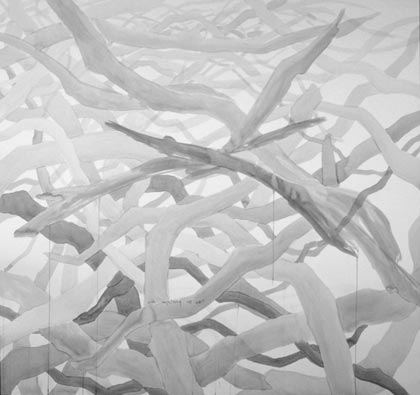 Fatigue, by Jay Walker
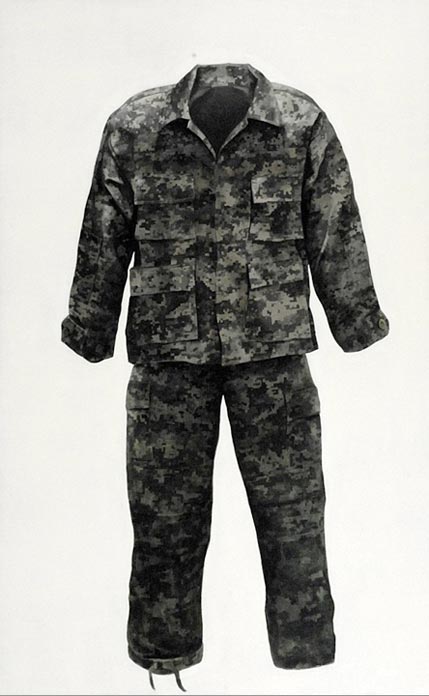
 Soft Serve, by Kevin Cyr

 Awakening

What is the role of a Christian artist? One of your paintings, for instance, shows a man sitting on a toilet — is there anything fundamentally Christian about that piece?
I think the role of the Christian artist is the same as that of a secular artist: to make the best artwork possible. . . . My work is inherently Christian because I am a Christian and my work comes out of who I am. I don’t think the highest calling for the Christian artist is to use his or her art as a platform for opinions, convictions, or beliefs. If art is to be anything other than preaching, illustrating, decorating (all of which have their place), it has to transcend what you, as an artist, are trying to say and actually become a living thing in its own right.
My Awakening series (of which the infamous man-on-toilet painting is one) was actually one of my more intentionally Christian projects. I might even call it allegorical. In doing those seven paintings, I was thinking about spiritual transformation and how you expect it to happen in the blink of an eye but it often happens incrementally. For me, going from being asleep to being awake and ready to face the day is a process . . . and involves lots of elaborate routines (revolving mostly around hot beverages). This relates to the process of going from spiritual deadness, stagnation, and denial to being spiritually awake and ready to face life or whatever you are presented with. . . . Discipline, or routine even, plays a role in this. You go through these small, seemingly insignificant processes and find yourself changed at the end without being able to see the exact moment when the change occurred.
[I’m] disappointed that my Awakening series is probably among the least likely of my projects to be displayed in a church or Christian setting, in spite of the fact that it was more consciously influenced by my faith than much of my other work. I think that art has a much higher capacity for being influential, in a positive way, in the church, but we have to be less afraid of incorporating things that we may not completely understand or be able to define.
 Fujimori Festival

Nate
:


Nate
:
Nate
:
Nate
: