Posts tagged landscape
 First we take Manhattan


 My Astronomical Romance
Nate
:

It’s not often that aesthetics are considered in the study of science, but [University of Chicago grad student Elizabeth] Kessler maintains it is necessary if one is to fully understand the space telescope and its impact.
“There’s a lot of translation that occurs between the data the Hubble collects and the final images that are shared with the public,” Kessler explains. Translating raw data into the “pretty pictures” that have become a staple of newspaper front pages requires careful image processing.
Astronomers and image specialists strive for realistic representations of the cosmos, yet they make subjective choices regarding contrast, composition and color. The Hubble images are complex representations of the cosmos that balance both art and science. In that sense, as well as in their appearance and emotional impact, Kessler says they resemble 19th century Romantic landscape paintings, especially those of the American West.
“The aesthetic choices made result in a sense of majesty and wonder about nature and how spectacular it can be, just as the paintings of the American West did,” Kessler said. “The Hubble images are part of the Romantic landscape tradition. They fit that popular, familiar model of what the natural world should look like.”

Nate
:Between common and professional
Nate
:Agriculturalists have long distrusted miners, millers, and other proponents of manufacturing; in a land where once nine of every ten people worked in agriculture, it is not surprising that much of our national heritage subtly emphasizes the good life of husbandry and the beauty and rightness of space shaped for farming. Equally significant in American culture is the tension between common and professional builders; while well-read men who understood the new theories of geography, mercantile capitalism, representative government, and innovative design sometimes directed colonization, people much less literate and far more traditional actually shaped the land. Very few cartographers and surveyors and spatial theorists migrated to the New World; men like William Penn were as rare as his finely drawn plan for Philadelphia, and even he did not stay to watch his plan take form.

Nate
:The mind is also a landscape
Nate
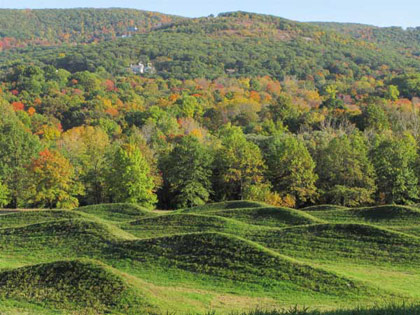
:Walking, ideally, is a state in which the mind, the body, and the world are aligned, as though they were three characters finally in conversation together, three notes suddenly making a chord. Walking allows us to be in our bodies and in the world without being made busy by them. It leaves us free to think without being wholly lost in our thoughts….
The rhythm of walking generates a kind of rhythm of thinking, and the passage through a landscape echoes or stimulates the passage through a series of thoughts. This creates an odd consonance between internal and external passage, one that suggests that the mind is also a landscape that was there all along, as though thinking were traveling rather than making.
Nate
:Why not do it well?
Andy
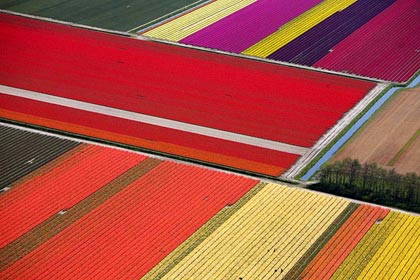
:Fans tuning in to the playoffs, which begin Wednesday, can expect to see 45-foot-wide swaths in a broadly woven pattern at Fenway Park, cross-hatched diamonds at Philadelphia’s Citizens Bank Park, straightaway outfield stripes at Dodger Stadium, a classic checkerboard at Wrigley Field, and the mingling three-directional outfield lines at Anaheim’s Angel Stadium, among others planned for the postseason.
Such designs adorn and distinguish nearly every major league ballpark these days, but no one takes as keen an interest in mowing patterns as [David] Mellor. He has written a book on the subject (“Picture Perfect: Mowing Techniques for Lawns, Landscapes, and Sports”), and is generally considered the top grass-cutting artist in the game. High-school geometry classes visit him at Fenway Park to study ways that an odd-shaped field can be divided and subdivided by straight lines and sharp angles.
“I’m not looking for more work,” Mellor said on a recent afternoon at Fenway Park. “But the grass has to be mowed anyway. So why not do it well, with straight lines, or checkerboards, or something more festive?”

Nate
: Tibetans Play Pool

Nate
:My pleasant uninteresting place
Nate
:A Chinese curse condemns one to live in interesting and eventful times. The best thing about Covington is that it is in a certain sense out of place and time but not too far out and therefore just the place for a Chinese scholar who asks nothing more than being left alone. One can sniff the ozone from the pine trees, visit the local bars, eat crawfish, and drink Dixie beer and feel as good as it is possible to feel in this awfully interesting century. And now and then, drive across the lake to New Orleans, still an entrancing city, eat trout amandine at Galatoire’s, drive home to my pleasant, uninteresting place, try to figure out how the world got into such a fix, shrug, take a drink, and listen to the frogs tune up.

Nate
: