Posts tagged horizons of the possible

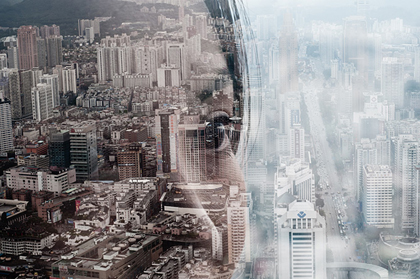
But what of the Empire Building? It was a thrilling experience to be whizzed in a “lift” a quarter of a mile heavenward, and to see New York spread out like a marvellous tapestry beneath us.
There was the Hudson – more like the flash of a sword-blade than a noble river. The little island of Manhattan, set like a jewel in its nest of rainbow waters, stared up into my face, and the solar system circled about my head! Why, I thought, the sun and the stars are suburbs of New York, and I never knew it! I had a sort of wild desire to invest in a bit of real estate on one of the planets. All sense of depression and hard times vanished, I felt like being frivolous with the stars.
 Good art in dark times
If what’s always distinguished bad writing—flat characters, a narrative world that’s cliched and not recognizably human, etc.—is also a description of today’s world, then bad writing becomes an ingenious mimesis of a bad world. If readers simply believe the world is stupid and shallow and mean, then Ellis can write a mean shallow stupid novel that becomes a mordant deadpan commentary on the badness of everything. Look man, we’d probably most of us agree that these are dark times, and stupid ones, but do we need fiction that does nothing but dramatize how dark and stupid everything is? In dark times, the definition of good art would seem to be art that locates and applies CPR to those elements of what’s human and magical that still live and glow despite the times’ darkness. Really good fiction could have as dark a worldview as it wished, but it’d find a way both to depict this world and to illuminate the possibilities for being alive and human in it.
Voluntary memory, the memory of the intellect and the eyes, [gives] us only imprecise facsimiles of the past which no more resemble it than pictures by bad painters resemble the spring…. So we don’t believe that life is beautiful because we don’t recall it, but if we get a whiff of a long-forgotten smell we are suddenly intoxicated, and similarly we think we no longer love the dead, because we don’t remember them, but if by chance we come across an old glove we burst into tears.
Metaphor as metastasis
What if, instead of that playful word bubble, we tried something a bit more accurately descriptive when growth at any cost became the goal. Say, “tumor”: “the dot-com tumor,” “the subprime tumor,” “the derivatives tumor.”
Would anyone seriously gainsay the highest possible vigilance over the proper functioning of their own body or doubt the need for strong regulation? Who, facing the prospect of a tumorous outbreak or living with a body demonstrably prone to such outbreaks, would entrust that body to a band of physicians blithely committed to laissez faire regarding these fatal bubbles of flesh?
Words matter. Metaphors frame thought. Pay them heed and tend them well.
 Patent US690236


“Olympic National Park is the listener’s Yosemite,” Hempton said of his decision to locate his One Square Inch within the park’s forested realm. “In a single day, you can listen to an alpine environment, a wilderness beach, and a temperate rain forest. And it has the longest noise-free interval of any national park I’ve been to, and I’ve been to them all.”
Part of Olympic’s quiet stems from its location: It sits on a peninsula in a secluded corner of the country. The park is not crossed by highways, navigable rivers, or utility rights of way; and it lies west of the major cross-country plane routes. Only three commercial-airline paths encroach upon its borders. Alaska Airlines is the most active, flying overhead 37 times each day in summer, but it tries to avoid the park during routine maintenance and training flights—a concession the carrier made to Hempton after he wrote asking it to change its flight patterns.

 Dinner with strangers
Religions, he thinks, have the buttons and know how to use them. His book considers the Catholic mass, early Christianitiy’s ritual of agape or love feasts, and Jewish Passover rituals to explore how religions encouraged us to overcome fear of strangers and create communities. He then tentatively imagines a so-called “agape restaurant” where, instead of dining with like-minded friends, you would be invited to eat with strangers. It would be the antithesis of Facebook.
Paving the home
Starting in 2000, a program in Mexico’s Coahuila state called “Piso Firme” (Firm Floor) offered up to $150 per home in mixed concrete, delivered directly to families who used it to cover their dirt floors. Scholar Paul Gertler evaluated the impact: Kids in houses that moved from all-dirt to all-concrete floors saw parasitic infestation rates drop 78 percent; the number of children who had diarrhea in any given month dropped by half; anemia fell more than four-fifths; and scores on cognitive tests went up by more than a third. (Perhaps unsurprisingly, mothers in newly cemented houses reported less depression and greater life satisfaction.) By 2005, Piso Firme had spread to other states, and 300,000 households—about 10 percent of dirt-floor houses in Mexico—had taken part in the program.
It helps if the street outside the house gets paved, too—not so much for health reasons as for economic ones. Economists Marco Gonzalez-Navarro and Climent Quintana-Domeque found in a 2010 study that paving the street in the town of Acayucan, Mexico, added more than 50 percent to land values and caused a 31 percent rise in rental values. It also considerably increased households’ access to credit. As a result, households on paved streets were 40 percent more likely to have cars.
The right to a horse
[T]echnology is an enabler of rights, not a right itself. There is a high bar for something to be considered a human right. Loosely put, it must be among the things we as humans need in order to lead healthy, meaningful lives, like freedom from torture or freedom of conscience. It is a mistake to place any particular technology in this exalted category, since over time we will end up valuing the wrong things. For example, at one time if you didn’t have a horse it was hard to make a living. But the important right in that case was the right to make a living, not the right to a horse. Today, if I were granted a right to have a horse, I’m not sure where I would put it.
New Years Rulin’s
 Lives of consequence
Old Jonathan Edwards wrote, “It has all along been God’s manner to open new scenes, and to bring forth to view things new and wonderful.” These scenes are the narrative method of the Bible, which assumes a steady march of history, the continuous unfolding of significant event, from the primordial quarrel of two brothers in a field to supper with a stranger at Emmaus. There is a cosmic irony in the veil of insignificance that obscures the new and wonderful. Moments of the highest import pass among people who are so marginal that conventional history would not have noticed them: aliens, the enslaved, people themselves utterly unaware that their lives would have consequence. The great assumption of literary realism is that ordinary lives are invested with a kind of significance that justifies, or requires, its endless iterations of the commonplace, including, of course, crimes and passions and defeats, however minor these might seem in the world’s eyes. This assumption is by no means inevitable. Most cultures have written about demigods and kings and heroes. Whatever the deeper reasons for the realist fascination with the ordinary, it is generous even when it is cruel, simply in the fact of looking as directly as it can at people as they are and insisting that insensitivity or banality matters. The Old Testament prophets did this, too.

And essentially the idea there is that one is making a kind of music in the way that one might make a garden. One is carefully constructing seeds, or finding seeds, carefully planting them and then letting them have their life. And that life isn’t necessarily exactly what you’d envisaged for them. It’s characteristic of the kind of work that I do that I’m really not aware of how the final result is going to look or sound. So in fact, I’m deliberately constructing systems that will put me in the same position as any other member of the audience. I want to be surprised by it as well. And indeed, I often am.
What this means, really, is a rethinking of one’s own position as a creator. You stop thinking of yourself as me, the controller, you the audience, and you start thinking of all of us as the audience, all of us as people enjoying the garden together. Gardener included. So there’s something in the notes to this thing that says something about the difference between order and disorder.
We can has cheeseburger!
Further reflection revealed that it’s quite impractical—nearly impossible—to make a cheeseburger from scratch. Tomatoes are in season in the late summer. Lettuce is in season in spring and fall. Large mammals are slaughtered in early winter. The process of making such a burger would take nearly a year, and would inherently involve omitting some core cheeseburger ingredients. It would be wildly expensive—requiring a trio of cows—and demand many acres of land. There’s just no sense in it.
A cheeseburger cannot exist outside of a highly developed, post-agrarian society. It requires a complex interaction between a handful of vendors—in all likelihood, a couple of dozen—and the ability to ship ingredients vast distances while keeping them fresh. The cheeseburger couldn’t have existed until nearly a century ago as, indeed, it did not.
A reading language

Outside the big cities, a very small minority of Indians – only seven to eight million – read in English. India has an overall rate of 65% literacy – measured in people’s own mother tongues. But where India drops into the Indian Ocean, in the state of Kerala, home of Malayalam literature, literacy is close to 100%. Not surprisingly, the population of Kerala – some 31 million – reads books.
Malayalam writers are in the enviable position of writing for [2008 Booker-prize-winning White Tiger author Aravind] Adiga’s rickshaw puller and not just about him.
Paul Zacharia, one of the best-known contemporary writers in Malayalam, says: “In the Indian picture, Kerala’s book readers are a record. They are the product both of the literacy movement and the earlier library movement spearheaded by a one-man army called PN Paniker [the founding father of the literacy movement in Kerala]. A whole world of grassroots readers keep emerging from the villages.” ...
In a recent report in The Hindu, Ravi DC, CEO of DC Books, Kerala’s leading publishing house, said the sale of Malayalam books has been growing by at least 30% a year. At the sixth international book fair, which DC Books organised in Kerala in November 2008, sales had doubled in a year. And, he added, “the demand for books in rural areas is on the increase”. The marketing strategy was now based on the concept that “books should go to people instead of people coming to book houses”.
“Your logo saves lives!”

A typical identity project involves plenty of personal creative investment, hours upon hours devoted to rounds of sketching, revisions, and the painstaking final tweaks to create a singular, perfect end result. Once the identity is complete and leaves our hands, though, we can’t protect the precious qualities of what we delivered, and it’s at the hands of clients to see if it remains in its intended form as time goes on. Yet, during a routine check-up call — something I do from time to time with previous clients — one of my logos definitely strayed from any branding guidelines, but, surprisingly, done so to the betterment and even salvation of populations living continents away.
During one such call, I spoke with Jennifer Dylan, Senior Manager of Creative Services at Mercy Corps, the aid organization for which we designed a new identity several years ago. “How is the brand identity going?” I asked, “Is the logo working in the field?” To which she answered, “Your logo saves lives!” That is by far the most unexpected and most profound response I have ever heard. She elaborated about how important it was for the victims to recognize the much-desired help and to differentiate it from not-so-well meaning people and the “enemy.” Just like the Red Cross is instantly recognizable, so too does Mercy Corps have to signal their brand on vehicles of any kind, on tents and primitive structures, on clothing, flags and banners, on wells and supplies, packages, and signs.
Strawberries and reindeer
Nate
:Cooking is universal among our species. Cooking is even more uniquely characteristic of our species than language. Animals do at least bark, roar, chirp, do at least signal by sound; only we bake, boil, roast and fry….
Few advances comparable in importance to cooking have happened since [its development]. The most important have been more quantitative than qualitative. We began not simply to harvest but to adopt certain palatable plants and animals as aids and conspirators. By 3,000 to 4,000 years ago, we had domesticated all those that have been central to our diets ever sense—barley, wheat, rice, maize, potatoes, sheep, goats, cattle, horses, and so on…. We have domesticated nothing more significant than strawberries and reindeer since.
Don’t be humble, either. This was one of my early mistakes. I was well aware that I was going to be subjected to this sort of skepticism. As a result, my initial projections were extremely conservative. Bad idea. In my first few meetings, I got the same reaction: People loved the concept, but were surprised at how little money we were going to generate. Despite the fact that our idea had potential, I’d attempted to temper expectations. Turns out, I’d tried so hard to avoid looking unrealistic that I ended up looking unimpressive. There was a middle ground I was missing. Don’t go overboard, but don’t sell yourself short.
In fact, this is the reason many people advocate integrating a situational analysis into your projections. Take three scenarios—not great, good, awesome—and show how they affect your profits and the amount of good your company can do. Make it as easy as possible to understand. “If we get this many customers, here’s what happens.” It takes a bit more research and a bit more time, but it’ll show that you’re planning ahead for contingencies—something any potential investor will appreciate.
 My kind of body art