Posts tagged europe
 Medieval job listings

booth man - one who sells grains
chapman - traveling merchant
collier - one who makes or sells charcoal
colporteur - seller of religious books
costermonger - fruit seller
drover - one who drives sheep or cattle to market
eggler - an egg-merchant


 Are carrots protestant?


 Re-bonjour
Nate
:
Everyone thinks that people in Paris are impossibly rude. The longer I spend in the city, the more I realise that this is untrue. In fact, they are impossibly polite. Understanding this is the secret to an effortless life in the French capital. Mastering lift etiquette is a good case in point. I arrived in Paris a few years ago from London, where even colleagues would rather stare blankly at the closed doors than venture a greeting. In Paris, by contrast, there is a tightly observed ritual. When the lift doors part, you step in and say “Bonjour”. Everybody says “Bonjour” back. Whenever anyone steps out, you wish them a “Bonne journée”. They do the same. And that’s not all. If later in the day you bump into anyone again, you start all over again with (I’m not making this up) “Re-bonjour”....
The general French respect for formality and form is nowhere more finely observed than in Paris. ... When my son was learning to write, his school report gave him marks for whether his boucles, or loops, of his joined-up letters respected to the millimetre the inter-line boundaries printed on the page. At the same time, he would bring back English exercise books filled with a chaotic caterpillar of mismatched letters. Why didn’t he use his neat handwriting in those books too, I asked him? He looked perplexed: “But that’s not how you write in English!”
All this points to the nature of every real story. It contains, openly or covertly, something useful. The usefulness may, in one case, consist in a moral; in another, in some practical advice; in a third, in a proverb or maxim. In every case the storyteller is a man who has counsel for his readers. But if today “having counsel” is beginning to have an old-fashioned ring, this is because the communicability of experience is decreasing. In consequence we have no counsel either for ourselves or for others. After all, counsel is less an answer to a question than a proposal concerning the continuation of a story which is just unfolding. To seek this counsel one would first have to be able to tell the story. (Quite apart from the fact that a man is receptive to counsel only to the extent that he allows his situation to speak.) Counsel woven into the fabric of real life is wisdom.

What that means is that, if we care about the sport as a story, we have to hope that the people in charge of running it do their jobs just badly enough to ensure that the Hand of God is possible. The wider the circle within which you’re willing to see the game as aesthetic, in other words, the more you wind up relying on chance and accident. If soccer is only a game—that is, aesthetic only in the most limited and technical sense—then it can achieve perfection as a deliberate design or as a successfully realized intention. If it’s a story—that is, aesthetic in a more primary sense—it can’t. If you want a masterpiece, the artist has to screw up. The lamest defense of bad refereeing in the world is “human error is part of the game.” It isn’t; but it is certainly, and problematically, part of the story.

 Medieval helpdesk
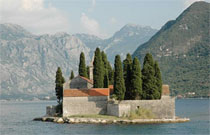
“In 1452,” we read at montenegro.com, “two sailors from Perast happened by a small rock jutting out of the bay after a long day at sea and discovered a picture of the Virgin Mary perched upon the stone.” Thus began a process of dumping more stones into the bay in order to expand this lonely, seemingly blessed rock—as well as loading the hulls of old fishing boats with stones in order to sink them beneath the waves, adding to the island’s growing landmass.
Eventually, in 1630, a small chapel was constructed atop this strange half-geological, half-shipbuilt assemblage.
Throwing stones into the bay and, in the process, incrementally expanding the island’s surface area, has apparently become a local religious tradition: “The custom of throwing rocks into the sea is alive even nowadays. Every year on the sunset of July 22, an event called fašinada, when local residents take their boats and throw rocks into the sea, widening the surface of the island, takes place.”
The idea that devotional rock-throwing has become an art of creating new terrain, generation after generation, rock after rock, pebble after pebble, is stunning to me. Perhaps in a thousand years, a whole archipelago of churches will exist there, standing atop a waterlogged maze of old pleasure boats and fishing ships, the mainland hills and valleys nearby denuded of loose stones altogether. Inadvertently, then, this is as much a museum of local geology—a catalog of rocks—as it is a churchyard.
Early warning system

I don’t believe in total freedom for the artist. Left on his own, free to do anything he likes, the artist ends up doing nothing at all. If there’s one thing that’s dangerous for an artist, it’s precisely this question of total freedom, waiting for inspiration and the rest of it.
—Federico Fellini, I'm a Born Liar
Not all thumbs
Nicoladis and colleagues studied one and two-hand counting gestures and cultural differences between Germans and French and English Canadians. While the majority of Germans use their thumb to begin to sequentially count, the majority of Canadians, both French and English, use their index finger as the numerical kick-off point when counting with their hands.
However, Nicoladis noted that some French Canadians also displayed anomalous differences from their Canadian or even their German counterparts.
“They show a lot more variation in what they are willing to use in terms of gestures, suggesting there might be some influence from the European French manner of gesturing (whose gestures are identical to the Germans’), or possibly other cultures too,” she said. “This association suggests that there are some cultural artifacts left over from these older French gestures and that they have been replaced because of the cultural contact with English Canadians.”

20. Best place to buy: Olive oil
Turkish embassy electrical supplies, London
The most unlikely olive oil vendor in the world? At his electrical supply shop in London’s Clerkenwell, Mehmet Murat sells wonderful, intensely fruity oil from his family’s olive groves in Cyprus and south-west Turkey. Now he imports more than a 1,000 litres per year. His lemon-flavoured oil is good enough to drink on its own.
76 Compton Street, London EC1, 020 7251 4721,www.planet mem.com
26. Best place to eat: Filipino cuisine
Lighthouse Restaurant, Cebu, Philippines
“The Lighthouse in Cebu in the Philippines is my favourite restaurant. We always eat bulalo (beef stew), banana heart salad, adobo (marinaded meat), baked oysters, pancit noodles, lechon de leche (suckling pig) and, to drink, green mango juice – my daughter is addicted to it! The staff are so friendly and welcoming. The chef has been there for more than 20 years, so the food is very consistent.”
Gaisano Country Mall, Banilad, Cebu city, Philippines, 0063 32 231 2478
Storytelling in sand
So many different kinds of lines
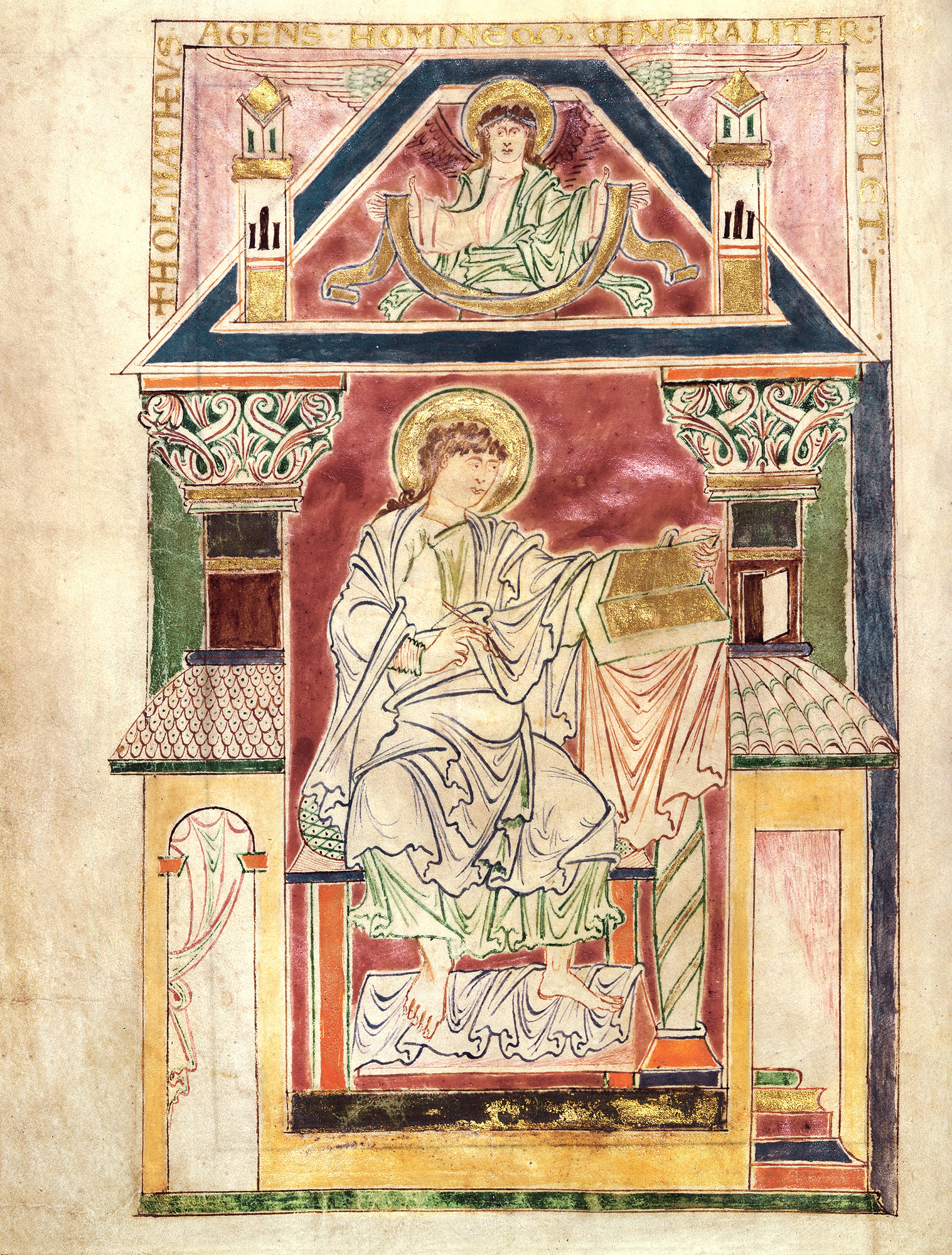

The exhibition is a knockout, at once sumptuous and restrained. The entire show fits into three galleries, but what galleries they are! Holcomb has gathered books and manuscripts from museums, libraries, and religious institutions in Europe and the United States. And it is in these bound volumes that the signal graphic achievements of the Middle Ages are to be found. Everybody, of course, knows the illuminated manuscripts of those centuries, with their dazzlingly colored pages, finished to a jewel-like shimmer. Holcomb’s great idea has been to set those works aside for the time being, and focus instead on what have traditionally perhaps been regarded as humbler fare. These are the pictures done with black or brown or sometimes colored ink, many of which have, at least at first glance, a more casual, more informal character. Such works, she argues, put us in touch with the medieval artist’s most immediate impressions and responses. I think she is absolutely right. There is an easygoing, wonderfully lowdown quality about a lot of the work in this show. We have gotten beyond the delicious formality of the illuminated manuscript. We are seeing artists in a variety of moods, sometimes ruminative or contemplative, at other times more intuitive, more playful. Even when the artists are doing something wonderfully elegant, it is an off-the-cuff elegance, an improvisational elegance. There are so many different kinds of lines to be seen in this show, from skeletal and attenuated to athletic and even frenetic. We see flashes of humor and wit, but also agitation, anxiety, and melancholy.
 “Dispatchwork” in Berlin

