Posts tagged clothing


 Reap what you sew

 The dude uniform

Most Indian men, at least those I see about town on the street, dress in what I call the “dude uniform”: a light-colored button-down long-sleeve shirt, slacks, and black sandals. As far as uniforms go, it’s pretty functional, working equally well for home and office, and requiring little in maintenance.
Younger guys, however, replace the sensible slacks with over-the-top denim: emulating their favorite Bollywood stars, they buy jeans that are dyed, streaked, distressed, and bedecked with clasps, latches, snaps, and pockets. Most of the time the pants are flared, giving them a bit of a disco feel.
On top, they wear a variety of shirts that make European clubwear appear dignified. Most are made of synthetic materials; gold lamé and neon orange are popular at the moment. Solid one-inch-wide black and orange vertical stripes were big in Fall 2008, but 2009 seems to favor a trompe l’oeil sweater-vest-over-T-shirt garment, usually in pastels. As far as I can tell, it’s the guys scraping by who wear the flashiest clothes. Too far down the socio-economic ladder and your duds turn to rags. Too far up and they become the dude uniform. Somewhere in between, though, is ‘70s gold.
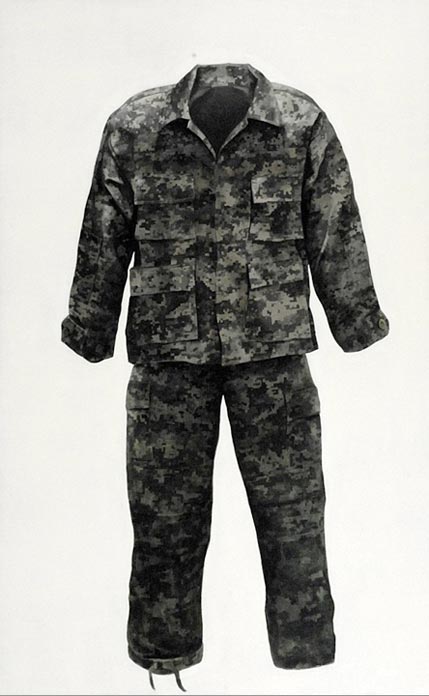
 Fatigue, by Jay Walker

 Fashion fasts and feasts

The Idea: Starting May 2009, I have pledged to wear one dress for one year as an exercise in sustainable fashion. Here’s how it works: There are 7 identical dresses, one for each day of the week. Every day I will reinvent the dress with layers, accessories and all kinds of accouterments, the majority of which will be vintage, hand-made, or hand-me-down goodies. Think of it as wearing a daily uniform with enough creative license to make it look like I just crawled out of the Marquis de Sade’s boudoir.
The Uniform Project is also a year-long fundraiser for the Akanksha Foundation, a grassroots movement that is revolutionizing education in India. At the end of the year, all contributions will go toward Akanksha’s School Project to fund uniforms and other educational expenses for slum children in India.
The Story of Uniforms: I was raised and schooled in India where uniforms were a mandate in most public schools. Despite the imposed conformity, kids always found a way to bend the rules and flaunt a little personality. Boys rolled up their sleeves, wore over-sized swatches, and hiked up their pants to show off their high-tops. Girls obsessed over bangles, bindis and bad hairdos. Peaking through the sea of uniforms were the idiosyncrasies of teen style and individual flare. I now want to put the same rules to test again, only this time I’m trading in the catholic school fervor for an eBay addiction and relocating the school walls to this wonderful place called the internet.
Nate
:When a modern Japanese family sits round the supper table eathing their bowls of Japanese-grown rice, they are not simply indulging a gastronomic preference for short-grain and slightly sticky Japonica rice over long-grain Indica rice from Thailand. They are eating and absorbing a tradition—in the sense of an invented and reinvented past. While the television beside the dining table pours out a stream of images of the here-and-now, of an urbanized, capitalist, and thoroughly internationalized Japan, each mouthful of rice offers communion with eternal and untainted Japanese values, with a rural world of simplicity and purity, inhabited by peasants tending tiny green farms in harmony with nature and ruled over by the emperor, descendant of the Sun Goddess, who plants and harvests rice himself each year in a special sacred plot. Simple peasant rice farmers are as marginal in contemporary Japan as hand-spinners are in India, but the small rice farm, like the swadeshi [homespun-style cloth] industry, lives on as a powerful symbol.

Nate
:

The struggle to adequately render letterforms on a pixel grid is a familiar one, and an ancient one as well: this bitmap alphabet is from La Vera Perfettione del Disegno di varie sorte di ricami, an embroidery guide by Giovanni Ostaus published in 1567.
Renaissance ‘lace books’ have much to offer the modern digital designer, who also faces the challenge of portraying clear and replicable images in a constrained environment. Ostaus’s alphabet follows the cardinal rule of bitmaps, which is to always reckon the height of a capital letter on an odd number of pixels. (Try drawing a capital E on both a 5×5 grid and a 6×6, and you’ll see.) Ostaus ignored the second rule, however, which is “leave space for descenders.”
I’d planned to introduce this item with a snappy headline that juxtaposed the old and the new — for your sixteenth-century Nintendo! — before reflecting on the pixel’s moribund existence. Pixels were the stuff of my first computer, which strained to show 137 of them in a square inch; my latest cellphone manages 32,562 in this same space, and has 65,000 colors to choose from, not eight. Its smooth anti-aliased type helps conceal the underlying matrix of pixels, which are nearly as invisible as the grains of silver halide on a piece of film. And its user interface reinforces this illusion using a trick borrowed from Hollywood: it keeps the type moving as much as possible.
Crisp cellphone screens aren’t the end of the story. There are already sharper displays on handheld remote controls and consumer-grade cameras, and monitors supporting the tremendous WQUXGA resolution of 3840×2400 are making their way from medical labs to living rooms. The pixel will never go away entirely, but its finite universe of digital watches and winking highway signs is contracting fast. It’s likely that the pixel’s final and most enduring role will be a shabby one, serving as an out-of-touch visual cliché to connote “the digital age.”

Nate
:
Nate
:They are called Mashghal in Arabic which literally means a working place, from the Arabic noun shoogal (work in general). This term was coined to refer to little shops where a group of usually Pakistani tailors make women dresses. About 30 years ago readymade women clothes were mostly unavailable to the general public and women drew designs on paper and took then to these tailor shops with fabric bought by the meter from areas similar to outdoor malls. For measurement, they would give the tailor a previously made dress that fits and he would use it as a measurement model. And that’s to avoid any physical contact between the tailor and the customer. I know now you’re wondering where did women get there first well measured dress and I too wonder.
These little tailor shops started to evolve into closed women shops where the tailors are women from the Philippines. The shops became bigger and the décor slightly better. However these women only shops are pricier, so the male version stuck around. The women mashghal started to quickly expand into the beauty salon business. So a women could go get her hair done and have a dress made at the same time. But when Al Eissaee, a big name in the fabric import business, started to also bring in quality readymade clothes, he started a huge trend that snowballed into our current mega malls. This in turn affected the tailor business for both the male and female shops. The male mostly went out of business except for a lucky few and the female shops concentrated more on the beauty salon side of the business, so much so that some even closed the dress making side. But for some unexplainable reason they are still called a mashghal even on official ministry of commerce licensing papers.
Tokyo vintage
Nate
:The story about vintage clothes in Tokyo goes like this: A Hollywood actress, after a successful crash diet, sold her size 6 wardrobe to a thrift shop in Santa Monica. Three months later she came to Tokyo to promote her latest movie and one afternoon wandered into one of the city’s landmark vintage clothing shops, called Santa Monica. What should she find there but her own shorts and several party dresses, unobtrusively displayed under a sign that read: “Santa Monica Style.”
The story is credible for the simple reason that Tokyo has now reached a point where it’s safe to call it Planet Vintage. Among the 400-plus shops scattered over the city, myths like this abound.
The good news is that it’s not all rumor and folklore - according to a fashion stylist, Keiko Okura, “the quality of Tokyo vintage products are unmatched.”
Andy
:Like the mass popularization of smiley face buttons in the early 1970s, which coincided with another oil and economic crisis, Life is good T-shirts have caught on among people who feel the products are spreading a positive message in a troubled world.
The invention of the smiley face is largely credited to Harvey Ross Ball, an advertising executive from Worcester, Mass., who drew the symbol in 1963 to improve worker morale at an insurance company that had merged with another.
It later became a fad when printed with the slogan “Have a nice day,” selling countless pieces of merchandise as an almost subversively counterintuitive message that in many ways seems to be repeating with “Life is good” today.
“The years when the company has thrived the most have been the most economically, politically and socially challenged years,” Mr. Jacobs said, adding that the company is on track to reach $135 million in sales this year through retail stores and a Web site. (In addition to the 4,500 stores that carry the Life is good merchandise, there are about 105 independently owned shops in airports and cities across the country that sell only Life is good products.) “The people who face the most adversity are the ones who embrace ‘Life is good’ the most,” he said.
Perfectly unfashionable
Andy
:Girls Gone Mild pays tribute to young women who have tangled with corporations and campus authorities to challenge the status quo. One such heroine is Ella Gunderson, who at age 11 appealed to Nordstrom for more modest clothing selections. It began with a shopping trip with her mother, 13-year-old sister Robin, and friends. When Robin tried on jeans that they agreed were too tight, they asked for the next size up—only to have the Nordstrom clerk advise them, “No you don’t want that size, you want the smaller size, the tighter size, because it’s The Look.”
That didn’t sit well with Ella. She wrote a letter to the company (her mother didn’t find out until Ella asked for help addressing it) expressing frustration at clothes cut too tight and too low and clerks too narrow in their concept of fashion. “I think you should change that,” Ella told Nordstrom.
A few months later—while the Gundersons were helping produce a local Pure Fashion show—they were surprised to receive two apologetic responses from the company. Ella’s letter and the Nordstrom responses were added to press kits prepared for the fashion show. Soon the story made the front page of the Seattle Times. Radio and television interviews followed, including an interview on the Today Show. Today‘s Katie Couric also interviewed Pete Nordstrom, who acknowledged receiving such complaints from other teenage girls for some time. A question raised at a stockholder meeting pressed the matter further with the company: “What do you plan to do about the Ella Gunderson issue?”
Albania’s sworn virgins
Nate
:The tradition of the sworn virgin can be traced to the Kanun of Leke Dukagjini, a code of conduct that has been passed on orally among the clans of northern Albania for more than five centuries. Under the Kanun, the role of women is severely circumscribed: Take care of children and maintain the home. While a woman’s life is worth half that of a man, a virgin’s value is the same - 12 oxen.
The sworn virgin was born of social necessity in an agrarian region plagued by war and death. If the patriarch of the family died with no male heirs, unmarried women in the family could find themselves alone and powerless. By taking an oath of virginity, women could take on the role of men as head of the family, carry a weapon, own property and move freely.
They dress like men, adopt a male swagger and spend their lives in the company of other men.