<?xml version="1.0" encoding="utf-8"?>
<feed xmlns="http://www.w3.org/2005/Atom" xml:lang="en">

    <title type="text">Culture Making Articles items tagged words</title>
    <subtitle type="text">Culture Making Articles:Writing on Christianity and culture from Andy Crouch</subtitle>
    <link rel="alternate" type="text/html" href="http://culture-makers.com/" />
    <link rel="self" type="application/atom+xml" href="https://culture-making.com/tag/atom" />
    <updated>2025-01-03T22:54:05Z</updated>
    <rights>Copyright (c) 2025, Andy Crouch</rights>
    <generator uri="http://www.pmachine.com/" version="7.5.15">ExpressionEngine</generator>
    <id>tag:culture-makers.com,2025:01:02</id>

    <entry>
      <title>And then your anthems raise</title>
      <link rel="alternate" type="text/html" href="https://culture-making.com/post/and_then_your_anthems_raise" />
      <id>tag:culture-makers.com,2025:author/1.1822</id>
      <published>2025-01-02T22:53:00Z</published>
      <updated>2025-01-03T22:54:05Z</updated>
      <author>
            <name>Andy Crouch</name>
            <email>andy@culture-making.com</email>
            
      </author>

      <content type="html"><![CDATA[


<p align="center"><a href="http://www.natebarksdale.com/2010/02/and-then-your-anthems-raise.html"><img width="420px" src="http://natebarksdale.typepad.com/.a/6a0120a672d95c970c0120a8adbd23970b-pi"></a></p>
<p>I&#8217;ve just launched my latest passion project, <a href="http://www.natebarksdale.com/2010/02/and-then-your-anthems-raise.html">A graphical analysis</a> of national anthem lyrics, with attention to religious expression, Olympic performance, and general bloodthirstiness.<br />


      ]]></content>
    </entry>    <entry>
      <title>The private languages of Lego</title>
      <link rel="alternate" type="text/html" href="https://culture-making.com/post/the_private_languages_of_lego" />
      <id>tag:culture-makers.com,2025:author/1.1716</id>
      <published>2025-01-02T22:53:00Z</published>
      <updated>2025-01-03T22:54:05Z</updated>
      <author>
            <name>Andy Crouch</name>
            <email>andy@culture-making.com</email>
            
      </author>

      <content type="html"><![CDATA[


					<b>Nate: </b><em>?I recall having a strong sense of Lego nomenclature as well, though I'm hazy on the details. I should go out to the storage bins in the garage to root around and see if the touch of plastic can retrieve any specific terms. Meanwhile, Language Log's Geoff Pullum <a href="http://languagelog.ldc.upenn.edu/nll/?p=1874">sums up</a> this delightful article well: "It's about the deep-seatedness of children's need to have names for all the things they deal with — and the lack of any necessity for there to be pre-existing names in the language they happen to have learned."?</em><br />
		
		<div style="float:right; padding:15px 5px 5px 5px"><a href="http://www.themorningnews.org/archives/opinions/a_common_nomenclature_for_lego_families.php"><img src="http://culture-making.com/media/legochart.jpg" alt="image"></a></div>
<p>Then, when another seven-year-old came round for tea after school one day, I overheard the two of them, busy in the spaceship construction yard that used to be our living room, get into a linguistic thicket.</p><p>“Can you see any clippy bits?” my son asked his friend. The friend was flummoxed. “Do you mean handy bits?” he asked, pointing.</p>
<p>“Yes,” replied my boy. “Clippy bits.”</p>
<p>Of course! This language of Lego isn’t just something our family has invented; every Lego-building family must have its own vocabulary. And the words they use (mostly invented by the children, not the adults) are likely to be different every time. But how different? And what sort of words?</p><hr />
<div class="author" style="font-size: -1">from "<a href="http://www.themorningnews.org/archives/opinions/a_common_nomenclature_for_lego_families.php">A Common Nomenclature for Lego Families</a>," by Giles Turnbull, <a href="http://www.themorningnews.org/archives/opinions/a_common_nomenclature_for_lego_families.php">The Morning News</a>, 4 November 2009 :: via <a href="http://www.languagehat.com/archives/003679.php">languagehat.com</a></div>		


      ]]></content>
    </entry>    <entry>
      <title>To arrr is human</title>
      <link rel="alternate" type="text/html" href="https://culture-making.com/post/to_arrr_is_human" />
      <id>tag:culture-makers.com,2025:author/1.1405</id>
      <published>2025-01-02T22:53:00Z</published>
      <updated>2025-01-03T22:54:05Z</updated>
      <author>
            <name>Andy Crouch</name>
            <email>andy@culture-making.com</email>
            
      </author>

      <content type="html"><![CDATA[


					<b>Nate: </b><em>?Why are pirates not just fascinating but downright charming, at least in the abstract? Why is it so tempting to think that the solution to our culture's embarrassing pirate fetish is to rename what we call piracy as something different: "software bootleggers"; "Somali ship-jackers"? Why is the idea of "<a href="http://www.talklikeapirate.com/">International Talk Like an Armed Robber Day</a>" unthinkable?  Put another way, why did the Jolly Roger fly from the flagpole at Apple Computer's headquarters while inside they were creating the first Macintosh? Why is the best way to get kids to attend an after-school program to hide its classrooms in the back of a <a href="http://www.826valencia.org/store/">pirate supply store</a>??</em><br />
		
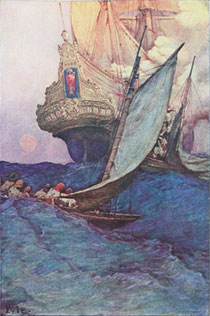
		<div style="float:right; padding:15px 5px 5px 5px"><img src="http://culture-making.com/media/6a00d8341c562c53ef01156f32fb5b970c-320wi.jpg" alt="image"></div><p>There is another aspect to our fascination with pirates. It is existential rather than political. It is about civilization and its limits, about our need for a sense of home versus a need to break those boundaries altogether. The sea has always played a big role in that dialectic. The sea is, potentially, an avenue for intercommunication and exchange among men. It is, in short, a vast shipping lane. But it is also an outer boundary. The land stops at the sea. The city stops at the sea. We human beings have conquered this earth, mostly and swiftly, but the sea is still unnatural territory for us, we aren\&#8216;t as sure on its surfaces as we are on those harder surfaces more suited to bipeds.</p>
<p>The pirate takes that insecurity and runs with it. Indeed, the word pirate can ultimately be traced back to the ancient Greek word &#8220;peira,&#8221; which means trial, attempt, experiment. To have <i>peira</i>, to posses <i>peira</i>, is to have gone through an experience. If I try something, I get to know it. In fact, it is out of the collecting of <i>peira</i> that a person constructs the greater web of experience (ex-<i>peira</i>) that makes one person, one person, and another, another.</p><p>The pirate is, quite literally, taking a chance. In doing so, pirates reenact the basic process that everyone goes through in becoming a person. You start out with very little sense of the world, and you gradually gain experience and put it all together. Pirates are simply less complacent than the rest of us. For reasons specific to historical circumstance and the accident of birth, some people decide to take that ultimate chance and continue to push the boundary of <i>peira</i>, to become a <i>peirate</i> — a pirate. Such figures dive back into the chaos of the sea, the edges of civilization, the end of the world. That such a journey is wrapped in physical danger, violence, moral ambiguity, cruelty, and heroism is only natural. Things are messy at the limits. Sureness dissolves at the boundaries.</p><hr />
<div class="author" style="font-size: -1">from "<a href="http://www.thesmartset.com/article/article04160901.aspx">Bootylicious</a>," by Morgan Meis, <a href="http://www.thesmartset.com/article/article04160901.aspx">The Smart Set</a>, 16 April 2009 :: via <a href="http://www.3quarksdaily.com/3quarksdaily/2009/04/bootylicious-the-love-affair-with-pirates.html">3quarksdaily</a></div>		


      ]]></content>
    </entry>    <entry>
      <title>You might be in a recession if …</title>
      <link rel="alternate" type="text/html" href="https://culture-making.com/post/you_might_be_in_a_recession_if" />
      <id>tag:culture-makers.com,2025:author/1.1273</id>
      <published>2025-01-02T22:53:00Z</published>
      <updated>2025-01-03T22:54:05Z</updated>
      <author>
            <name>Andy Crouch</name>
            <email>andy@culture-making.com</email>
            
      </author>

      <content type="html"><![CDATA[


			<b><p>Nate</p>: </b><em>?Reassuring news for <a href="http://www.fabu.com/brand/britneyspears">this site</a> at least.?</em><br />

<div class="author" style="font-size: -1">A <a href="http://freakonomics.blogs.nytimes.com/2009/01/29/sign-o-the-times/">NYTimes.com Freakonomics Blog</a> post by Justin Wolfers, 29 January 2009</div><hr />		
		<p>The <a href="http://bocowgill.com/2009/01/you-know-its-recession-when-more-people.html">latest recession indicator</a>: more people are searching Google for “coupons” than for “<strong>Britney Spears</strong>.” And <a href="http://www.google.com/insights/search/#q=Britney spears,&amp;cmpt=q">it’s not</a> that Britney is getting less popular. By this measure, the recession began in March 2008. Check out the full time series, <a href="http://www.google.com/insights/search/#q=Britney spears,coupon&amp;date=1/2005 49m&amp;cmpt=q">here</a>.</p>


      ]]></content>
    </entry>    <entry>
      <title>Inklings into thoughts and thoughts into words</title>
      <link rel="alternate" type="text/html" href="https://culture-making.com/post/inklings_into_thoughts_and_thoughts_into_words" />
      <id>tag:culture-makers.com,2025:author/1.1261</id>
      <published>2025-01-02T22:53:00Z</published>
      <updated>2025-01-03T22:54:05Z</updated>
      <author>
            <name>Andy Crouch</name>
            <email>andy@culture-making.com</email>
            
      </author>

      <content type="html"><![CDATA[


		<p>I would write ads for deodorants or labels for catsup bottle, if I had to. The miracle of turning inklings into thoughts and thoughts into words and words into metal and print and ink never palls for me.</p><br />
		<p><small>	&mdash;John Updike, <i>Paris Review</i> interview (1967) :: via Daring Fireball</small></p>


      ]]></content>
    </entry>    <entry>
      <title>We speak volumes</title>
      <link rel="alternate" type="text/html" href="https://culture-making.com/post/we_speak_volumes" />
      <id>tag:culture-makers.com,2025:author/1.1244</id>
      <published>2025-01-02T22:53:00Z</published>
      <updated>2025-01-03T22:54:05Z</updated>
      <author>
            <name>Andy Crouch</name>
            <email>andy@culture-making.com</email>
            
      </author>

      <content type="html"><![CDATA[


					<b><p>Nate</p>: </b><em>?From my current morning reading, the 1987 Booker Prize novel.?</em><br />
		
		<p>Today language abandoned me. I could not find the word for a simple object—a commonplace familiar furnishing. For an instant, I stared into a void. Language tethers us to the world; without it we spin like atoms. Later, I made an inventory of the room—a naming of parts: bed, chair, table, picture, vase, cupboard, window, curtain. Curtain. And I breathed again.</p><p>We open our mouths and out flow words whose ancestries we do not even know. We are walking lexicons. In a single sentence of idle chatter we preserve Latin, Anglo-Saxon, Norse; we carry a museum inside our heads, each day we commemorate peoples of whom we have never heard. More than that, we speak volumes—our language is the language of everything we have not read. Shakespeare and the Authorized Version surface in supermarkets, on buses, chatter on radio and television. I find this miraculous. I never cease to wonder at it. That words are more durable than anything, that they blow with the wind, hibernate and reawaken, shelter parasitic on the most unlikely hosts, survive and survive and survive.</p><hr />
<div class="author" style="font-size: -1">from <i><a href="http://en.wikipedia.org/wiki/Moon_Tiger">Moon Tiger</a>,</i> by Penelope Lively (1987), pp.40–41</div>		


      ]]></content>
    </entry>    <entry>
      <title>Crosstown crosswords</title>
      <link rel="alternate" type="text/html" href="https://culture-making.com/post/crosstown_crosswords" />
      <id>tag:culture-makers.com,2025:author/1.1206</id>
      <published>2025-01-02T22:53:00Z</published>
      <updated>2025-01-03T22:54:05Z</updated>
      <author>
            <name>Andy Crouch</name>
            <email>andy@culture-making.com</email>
            
      </author>

      <content type="html"><![CDATA[


					<b><p>Nate</p>: </b><em>?A pretty cool use of a blank Ukrainian building face. Though the symmetrical black squares do call to mind a combination of Tetris and Space Invaders—I'm not sure if that's an asset or not.?</em><br />

		
		<div style="float:right; padding:15px 5px 5px 5px"><img src="http://culture-making.com/media/1_420.jpg" alt="image"></div><p>People of Lvov city in Ukraine decided to add another attraction for the visitors of their city. According to the artistic project it was decided to place a giant 100 feet (30 meters) tall at the wall of the one of the multi-stored residential houses. </p><p>There is one interesting detail about the design of the puzzle. It looks like an empty puzzle during the day-light, but at night when special lights are on the words in the puzzle become visible with a lightly-glowing fluorescent color.</p><p>The questions for this crossword puzzle are located in different point of interests of the city, like monuments, theaters, fountains etc. So people while walking around the city can try to answer the questions and writing down the answers. When the night comes to the city they can meet at this house and check their degree of intelligence.</p><hr />
<div class="author" style="font-size: -1">from "<a href="http://englishrussia.com/?p=2197">A Puzzle on the House</a>," <a href="http://englishrussia.com/?p=2197">English Russia</a>, 7 January 2009</div>		


      ]]></content>
    </entry>    <entry>
      <title>Remember (I was torn between), by Jay Kelly</title>
      <link rel="alternate" type="text/html" href="https://culture-making.com/post/remember_i_was_torn_between_by_jay_kelly" />
      <id>tag:culture-makers.com,2025:author/1.1091</id>
      <published>2025-01-02T22:53:00Z</published>
      <updated>2025-01-03T22:54:05Z</updated>
      <author>
            <name>Andy Crouch</name>
            <email>andy@culture-making.com</email>
            
      </author>

      <content type="html"><![CDATA[


					<b><p>Nate</p>: </b><em>?Southern California artist Jay Kelly's collages are arresting and uplifting, messy and beautiful, painterly and graphic designer-ish—and just the slightest bit repetitive (looking at a whole year's work on one of his <a href="http://www.jkfineart.com/gallery2008.html">gallery pages</a> feels a bit like perusing the motivational artwork at the offices of the world's coolest corporation). But one or two at a time, they're really something.?</em><br />
		
		<a href="http://www.jkfineart.com/"><img src="http://culture-making.com/media/2008-Remember-pop.jpg" alt="image" /></a><hr />
<div class="author" style="font-size: -1">"Remember (I was torn between)" 2008, collage, acrylic and resin on wood panel, by <a href="http://www.jkfineart.com/">Jay Kelly</a> :: via <a href="http://www.dailyserving.com/2008/11/jay_kelly.php">DailyServing.com</a></div>		


      ]]></content>
    </entry>    <entry>
      <title>If it seems wordish, use it.</title>
      <link rel="alternate" type="text/html" href="https://culture-making.com/post/if_it_seems_wordish_use_it" />
      <id>tag:culture-makers.com,2025:author/1.768</id>
      <published>2025-01-02T22:53:00Z</published>
      <updated>2025-01-03T22:54:05Z</updated>
      <author>
            <name>Andy Crouch</name>
            <email>andy@culture-making.com</email>
            
      </author>

      <content type="html"><![CDATA[


					<b><p>Nate</p>: </b><em>?Oddly, I've never been too enthused by the "there oughta be a word for X" genre (<i>Sniglets</i>, etc.). But I am a huge fan of new words that actually get used, even if they annoy the traditionalists at first. Part of glory of language is the freedom it gives us to come up witn entirely new, yet comprehensible combinations of words and word-parts.?</em><br />
		
		<p>Part of the joy and pleasure of English is its boundless creativity: I can describe a new machine as bicyclish, I can say that I’m vitamining myself to stave off a cold, I can complain that someone is the smilingest person I’ve ever seen, and I can decide, out of the blue, that fetch is now the word I want to use to mean “cool.” By the same token, readers and listeners can decide to adopt or ignore any of these uses or forms.</p>
<p>So, please, leave off the “not a real word” apologia. A far better (and dare I say, funner) technique is to jump in with both feet and use whatever word strikes your fancy. Instead of being defensive, demand that any who dare to quibble over your use prove that your word is, in fact, not a word.</p><p>In short, if it seems wordish, use it. No apologies necessary.</p><hr />
<div class="author" style="font-size: -1">from "<a href="http://www.boston.com/bostonglobe/ideas/articles/2008/08/03/chillax/">Chillax</a>," by Erin McKean, <a href="http://www.boston.com/bostonglobe/ideas/articles/2008/08/03/chillax/"><i>Boston Globe</i> op-ed</a>, 3 August 2008 :: via <a href="http://www.boingboing.net/2008/08/27/english-is-a-usermod.html">Boing Boing</a></div>		


      ]]></content>
    </entry>

</feed>