<?xml version="1.0" encoding="utf-8"?>
<feed xmlns="http://www.w3.org/2005/Atom" xml:lang="en">

    <title type="text">Culture Making items tagged internet</title>
    <subtitle type="text">Culture Making:Main column content</subtitle>
    <link rel="alternate" type="text/html" href="http://www.culture-making.com/author/" />
    <link rel="self" type="application/atom+xml" href="http://www.culture-making.com/tag/atom/" />
    <updated>2012-02-08T19:38:35Z</updated>
    <rights>Copyright (c) 2012, Nate Barksdale</rights>
    <generator uri="http://www.pmachine.com/" version="1.7.0">ExpressionEngine</generator>
    <id>tag:culture-making.com,2012:02:08</id>


    <entry>
      <title>The right to a horse</title>
      <link rel="alternate" type="text/html" href="http://www.culture-making.com/post/the_right_to_a_horse/" />
      <id>tag:culture-making.com,2012:author/9.2015</id>
      <published>2012-02-08T14:29:34Z</published>
      <updated>2012-02-08T19:38:35Z</updated>
      <author>
            <name>Nate Barksdale</name>
            <email>natebarksdale@gmail.com</email>
                  </author>

      <content type="html"><![CDATA[


					<b>Nate: </b><em>“One of the key figures in the creation of the Internet suggests we should be careful about enshrining any technology as a human right. That it is tempting to do so says a lot about many technologies' ability to enable incredible (and deeply humanizing) things, but also about their tendency to seem more irresistible and permanent than they really are.”</em><br />		
		<p>[T]echnology is an enabler of rights, not a right itself. There is a high bar for something to be considered a human right. Loosely put, it must be among the things we as humans need in order to lead healthy, meaningful lives, like freedom from torture or freedom of conscience. It is a mistake to place any particular technology in this exalted category, since over time we will end up valuing the wrong things. For example, at one time if you didn’t have a horse it was hard to make a living. But the important right in that case was the right to make a living, not the right to a horse. Today, if I were granted a right to have a horse, I’m not sure where I would put it.</p><hr />
<div class="author" style="font-size: -1">from "<a href="http://www.nytimes.com/2012/01/05/opinion/internet-access-is-not-a-human-right.html">Internet Access Is Not a Human Right</a>," by Vint Cerf, <a href="http://www.nytimes.com/2012/01/05/opinion/internet-access-is-not-a-human-right.html"><em>The New York Times</em></a>, 4 January 2012 :: via <a href="http://www.wired.com/epicenter/2012/01/net-not-a-human-right/#">Wired.com</a></div>		


      ]]></content>
    </entry>

    <entry>
      <title>Solving the three ring binder problem</title>
      <link rel="alternate" type="text/html" href="http://www.culture-making.com/post/solving_the_three_ring_binder_problem/" />
      <id>tag:culture-making.com,2012:author/9.2009</id>
      <published>2012-02-08T14:29:34Z</published>
      <updated>2012-02-08T19:38:35Z</updated>
      <author>
            <name>Nate Barksdale</name>
            <email>natebarksdale@gmail.com</email>
                  </author>

      <content type="html"><![CDATA[


					<b>Nate: </b><em>“<a href="http://homeless-scc.org/">Homeless: Santa Clara County</a> is a web-based app designed to connect people who are homeless in communities in and near Silicon Valley with relevant services.  It offers a step beyond the typical three ring binder full of referral info and notes that social workers and other advocates typically wind up relying on to keep track of where people can go for what kinds of help. The app, still in beta, was just awarded second <a href="http://appsforcommunities.challenge.gov/submissions/2732-homeless-scc-santa-clara-county">second prize</a> in Challenge.gov's "<a href="http://appsforcommunities.challenge.gov/">Apps for Communities</a>" contest. Congratulations to our friend Curtis Chang and his team at <a href="http://consultingwithinreach.com/">Consulting Within Reach</a> for their work developing this resource.”</em><br />		
		<a href="http://appsforcommunities.challenge.gov/submissions/2732-homeless-scc-santa-clara-county"><img src="http://www.culture-making.com/media/homeless.jpg" alt="image" /></a><hr />
<div class="author" style="font-size: -1">map search from <a href="http://homeless-scc.org/">Homeless-SCC (beta)</a>,  15 December 2011</div>		


      ]]></content>
    </entry>

    <entry>
      <title>A book holds your hand in solitude</title>
      <link rel="alternate" type="text/html" href="http://www.culture-making.com/post/a_book_holds_your_hand_in_solitude/" />
      <id>tag:culture-making.com,2012:author/9.1490</id>
      <published>2012-02-08T14:29:34Z</published>
      <updated>2012-02-08T19:38:35Z</updated>
      <author>
            <name>Nate Barksdale</name>
            <email>natebarksdale@gmail.com</email>
                  </author>

      <content type="html"><![CDATA[


					<b>Nate: </b><em>“Book sales are declining in nearly every category, but young adult book sales continue to rise. Do today's teenage readers offer <a href="http://gawker.com/5277281/dave-eggers-reassures-us-that-print-lives-via-email">hope for a more literate future</a> after all? Or, as a <a href="http://futurismic.com/2009/06/22/young-adult-fiction-are-we-confusing-marketing-with-markets/">perceptive commenter</a> asks, are YA titles simply successful because they're being read and enjoyed by more than just young adults?”</em><br />		
		<p>Certainly, the increasing quality of young adult books is a draw. But there are exceptional videogames, there are exceptional websites and exceptional television programs to fight for a teenager’s attention. So why are they still reading?</p><p>I think there is another reason why young adult novels are doing well, and it is less easy gauge. As of yet, there are no real studies determining this, but anecdotally, we all relate to it. A book is an opportunity to get “off the grid.” We read to break free of their digital tether. To experience what life was like before the net. To disconnect. To finally feel alone. </p><p>A book holds your hand in solitude and says, here you are alone in your room and everything is alright. You don’t need to call a friend or Twitter something. The world is still turning. If you go for a forty minute walk without your mobile, don’t worry, you’re not going to miss anything.</p><hr />
<div class="author" style="font-size: -1">from "<a href="http://www.tomorrowmuseum.com/2009/06/20/why-teenagers-read-better-than-you/">Why Teenagers Read Better Than You</a>," by Joanne McNeil, <a href="http://www.tomorrowmuseum.com/2009/06/20/why-teenagers-read-better-than-you/">Tomorrow Museum</a>, 20 June 2009 :: first posted here 23 June 2009</div>		


      ]]></content>
    </entry>

    <entry>
      <title>Moby Dick, a book about computers</title>
      <link rel="alternate" type="text/html" href="http://www.culture-making.com/post/moby_dick_a_book_about_computers/" />
      <id>tag:culture-making.com,2012:author/9.1606</id>
      <published>2012-02-08T14:29:34Z</published>
      <updated>2012-02-08T19:38:35Z</updated>
      <author>
            <name>Nate Barksdale</name>
            <email>natebarksdale@gmail.com</email>
                  </author>

      <content type="html"><![CDATA[


      ]]></content>
    </entry>

    <entry>
      <title>日々の音色 (Hibi no neiro), video by SOUR and friends</title>
      <link rel="alternate" type="text/html" href="http://www.culture-making.com/post/hibi_no_neiro_video_by_sour_and_friends/" />
      <id>tag:culture-making.com,2012:author/9.1513</id>
      <published>2012-02-08T14:29:34Z</published>
      <updated>2012-02-08T19:38:35Z</updated>
      <author>
            <name>Nate Barksdale</name>
            <email>natebarksdale@gmail.com</email>
                  </author>

      <content type="html"><![CDATA[


			<p align="center"><a href="http://www.youtube.com/watch?v=WfBlUQguvyw"><img src="http://culture-making.com/media/sour.jpg" alt="image"></a></p><br />
<b>Nate: </b><em>“Nothing says Friday like a bit of crowdsourced J-pop: "The cast were selected from the actual Sour fan base, from many countries around the world. Each person and scene was filmed purely via webcam."”</em><br /><hr /><span style="font-size: -1"><a href="http://www.youtube.com/watch?v=WfBlUQguvyw">"日々の音色 (Hibi no neiro)"</a>," by <a href="http://sour-web.com/">SOUR</a>, 1 July 2009 :: thanks <a href="http://twitter.com/jonathanhliu">@jonathanhliu</a></span>


      ]]></content>
    </entry>

    <entry>
      <title>Into the scrum</title>
      <link rel="alternate" type="text/html" href="http://www.culture-making.com/post/into_the_scrum/" />
      <id>tag:culture-making.com,2012:author/9.1488</id>
      <published>2012-02-08T14:29:34Z</published>
      <updated>2012-02-08T19:38:35Z</updated>
      <author>
            <name>Nate Barksdale</name>
            <email>natebarksdale@gmail.com</email>
                  </author>

      <content type="html"><![CDATA[


					<b>Nate: </b><em>“The world-changing potential of new technologies is often best realized not by people whose initial goal was to change the world, but by those who dove into smaller passion projects, put in their hours and honed their craft without an eye on earth-shattering outcomes.”</em><br />		
		<p>From his experience as a founder of Global Voices, an aggregator of citizen media from around the world, Mr. Zuckerman says he has learned to value the roots laid down by a community of bloggers. </p><p>In Kenya, he said, bloggers were important commentators and reporters in 2007-8 on a disputed election, and people would ask why there were so many bloggers in Kenya. </p><p>It turned out, he said, that “Kenya has the second-most bloggers in Africa and that mostly they are not writing about politics; many are writing about rugby.” There was, he said, “a fascinating latent capacity — people who knew how to use the tools, knew how to write well, to tell a story with words and pictures.”</p><p>The Russia-Georgia war, he said, offered a contrast. </p><p>“Suddenly a bunch of people flocked to blogging tools,” he said. “We had never heard about of lot of those people. A number of people were manufacturing blogs from whole cloth for propaganda purposes. It was hard to know who they were, if they were credible. In Kenya, we knew who they were; we knew their favorite rugby team.”</p><hr />
<div class="author" style="font-size: -1">from "<a href="http://www.nytimes.com/2009/06/22/technology/internet/22link.html?_r=1&hpw;">As Blogs Are Censored, It’s Kittens to the Rescue</a>," by Noam Cohen, <a href="http://www.nytimes.com/2009/06/22/technology/internet/22link.html?_r=1&hpw;">NYTimes.com</a>, 21 June 2009</div>		


      ]]></content>
    </entry>

    <entry>
      <title>Eat when you eat</title>
      <link rel="alternate" type="text/html" href="http://www.culture-making.com/post/eat_when_you_eat/" />
      <id>tag:culture-making.com,2012:author/9.1455</id>
      <published>2012-02-08T14:29:34Z</published>
      <updated>2012-02-08T19:38:35Z</updated>
      <author>
            <name>Nate Barksdale</name>
            <email>natebarksdale@gmail.com</email>
                  </author>

      <content type="html"><![CDATA[


					<b>Nate: </b><em>“File under "The Medium is the Message" ...”</em><br />		
		<p>The dominant revenue model of the web today—the ad that urges a click—embeds distraction into interface design. The more clicks you take—the more Google makes in ad revenue (distraction pays). This is not to say that social media doesn’t have extraordinary value—it does. It is at  the heart the emerging social nervous system. Yet, the ability to pay attention, focus and strategically disconnect will be a winning discipline of the next generation of business leaders. As the zen phrase says, “eat when you eat” meaning, give each thing you do all of your attention.</p><hr />
<div class="author" style="font-size: -1">from "<a href="http://www.opposableplanets.com/uncategorized/2009/05/the-real-time-web-is-a-beautiful-distraction/">The Real Time Web is a Beautiful Distraction</a>," by Joshua-Michéle, <a href="http://www.opposableplanets.com/uncategorized/2009/05/the-real-time-web-is-a-beautiful-distraction/">Opposable Planets</a>, 8 May 2009 :: via <a href="http://www.kottke.org/09/05/focus-on-focusing">Kottke.org</a></div>		


      ]]></content>
    </entry>

    <entry>
      <title>Drinking less, online</title>
      <link rel="alternate" type="text/html" href="http://www.culture-making.com/post/drinking_less_online/" />
      <id>tag:culture-making.com,2012:author/9.1450</id>
      <published>2012-02-08T14:29:34Z</published>
      <updated>2012-02-08T19:38:35Z</updated>
      <author>
            <name>Nate Barksdale</name>
            <email>natebarksdale@gmail.com</email>
                  </author>

      <content type="html"><![CDATA[


					<b>Nate: </b><em>“Here's a very different approach to temperance and addiction, one likely at least as controversial to the 12-step community as the successful Italian drug rehab facility that <a href="http://www.theatlantic.com/doc/200609/wine-therapy">runs a very nice winery</a>: the goal of the self-help program is to get people's drinking down to what the Dutch government regards as low-risk levels: "Dutch guidelines in terms of American drinks would mean: less than 15 drinks per week and no more than five in a row for men; and for women, no more than 10 drinks per week and no more than three in a row."”</em><br />		
		<p>Problem drinking in Western societies contributes to disease and death as well as social and economic woes.  Yet only a small number of people with alcohol problems – 10 to 20 percent – ever seek and participate in treatment.  This study examined the real-world effectiveness of a 24/7 free-access, anonymous, interactive, and Web-based self-help intervention called Drinking Less (DL) at <a href="http://www.minderdrinken.nl" rel="nofollow">http://www.minderdrinken.nl</a>.  Findings show that DL can help problem drinkers in the privacy of their own homes.</p><hr />
<div class="author" style="font-size: -1">from "<a href="http://www.sciencedaily.com/releases/2009/05/090512192905.htm">Web-based, Self-help Intervention Can Aid Problem Drinkers In The Privacy Of Their Homes</a>," <a href="http://www.sciencedaily.com/releases/2009/05/090512192905.htm">ScienceDaily</a>, 19 May 2009</div>		


      ]]></content>
    </entry>

    <entry>
      <title>Why loot when you can fake?</title>
      <link rel="alternate" type="text/html" href="http://www.culture-making.com/post/why_loot_when_you_can_fake/" />
      <id>tag:culture-making.com,2012:author/9.1431</id>
      <published>2012-02-08T14:29:34Z</published>
      <updated>2012-02-08T19:38:35Z</updated>
      <author>
            <name>Nate Barksdale</name>
            <email>natebarksdale@gmail.com</email>
                  </author>

      <content type="html"><![CDATA[


					<b>Nate: </b><em>“Archeologists feared that eBay would democratize antiques trafficking, increasing demand and causing more ancient sites to be looted. But things haven't worked out that way ...”</em><br />		
		<p>By improving access to a worldwide market, eBay has inadvertently created a vast market for copies of antiquities, diverting whole villages from looting to producing fake artifacts, Stanish writes. The proliferation of these copies also has added new risks to buying objects billed as artifacts, which in turn has worked to depress the market for these items, further reducing incentives to loot.</p><hr />
<div class="author" style="font-size: -1">from "<a href="http://www.sciencedaily.com/releases/2009/05/090504193641.htm">EBay Has Unexpected, Chilling Effect On Looting Of Antiquities, Archaelogist Finds</a>," <a href="http://www.sciencedaily.com/releases/2009/05/090504193641.htm">ScienceDaily</a>, 9 May 2009</div>		


      ]]></content>
    </entry>

    <entry>
      <title>Why advertising will fail</title>
      <link rel="alternate" type="text/html" href="http://www.culture-making.com/post/why_advertising_will_fail/" />
      <id>tag:culture-making.com,2012:author/9.1378</id>
      <published>2012-02-08T14:29:34Z</published>
      <updated>2012-02-08T19:38:35Z</updated>
      <author>
            <name>Nate Barksdale</name>
            <email>natebarksdale@gmail.com</email>
                  </author>

      <content type="html"><![CDATA[


					<b>Andy: </b><em>“Provocative and, my gut instinct tells me, basically correct.”</em><br />		
		<p>My basic premise is that the internet is not replacing advertising but shattering it, and all the king’s horses, all the king’s men, and all the creative talent of Madison Avenue cannot put it together again. . . . </p><p>It is frequently argued that the advertising industry will provide sufficient innovation to replace the loss of traditional ads on traditional mass media. Again, my basic premise rejects this, suggesting that simple commercial messages, pushed through whatever medium, in order to reach a potential customer who is in the middle of doing something else, will fail. It’s not that we no longer need information to initiate or to complete a transaction; rather, we will no longer need advertising to obtain that information. We will see the information we want, when we want it, from sources that we trust more than paid advertising. We will find out what we need to know, when we want to make a commercial transaction of any kind. The conventional wisdom is that this is exactly what paid search helps us to do, but all too often they are nothing more than a form of misdirection . . . [later defined as] diverting customers to companies that they do not wish to find, simply because the customer’s preferred company underbid.</p><hr />
<div class="author" style="font-size: -1">from "<a href="http://www.techcrunch.com/2009/03/22/why-advertising-is-failing-on-the-internet/">Why Advertising Is Failing On The Internet</a>," by Eric Clemons, <a href="http://www.techcrunch.com/">TechCrunch</a>, 22 March 2009 :: via <a href="http://ideas.blogs.nytimes.com/">Idea of the Day Blog - NYTimes.com</a></div>		


      ]]></content>
    </entry>

    <entry>
      <title>The end of publishing</title>
      <link rel="alternate" type="text/html" href="http://www.culture-making.com/post/the_end_of_publishing/" />
      <id>tag:culture-making.com,2012:author/9.1343</id>
      <published>2012-02-08T14:29:34Z</published>
      <updated>2012-02-08T19:38:35Z</updated>
      <author>
            <name>Nate Barksdale</name>
            <email>natebarksdale@gmail.com</email>
                  </author>

      <content type="html"><![CDATA[


					<b>Andy: </b><em>“A typically insightful, indispensable essay by Clay Shirky.”</em><br />		
		<p>“If the old model is broken, what will work in its place?” To which the answer is: Nothing. Nothing will work. There is no general model for newspapers to replace the one the internet just broke.</p><p>With the old economics destroyed, organizational forms perfected for industrial production have to be replaced with structures optimized for digital data. It makes increasingly less sense even to talk about a publishing industry, because the core problem publishing solves — the incredible difficulty, complexity, and expense of making something available to the public — has stopped being a problem.</p><hr />
<div class="author" style="font-size: -1">from "<a href="http://www.shirky.com/weblog/2009/03/newspapers-and-thinking-the-unthinkable/">Newspapers and Thinking the Unthinkable</a>," by <a href="http://www.shirky.com/">Clay Shirky</a>, 13 March 2009</div>		


      ]]></content>
    </entry>

    <entry>
      <title>You might be in a recession if …</title>
      <link rel="alternate" type="text/html" href="http://www.culture-making.com/post/you_might_be_in_a_recession_if/" />
      <id>tag:culture-making.com,2012:author/9.1273</id>
      <published>2012-02-08T14:29:34Z</published>
      <updated>2012-02-08T19:38:35Z</updated>
      <author>
            <name>Nate Barksdale</name>
            <email>natebarksdale@gmail.com</email>
                  </author>

      <content type="html"><![CDATA[


			<b>Nate: </b><em>“Reassuring news for <a href="http://www.fabu.com/brand/britneyspears">this site</a> at least.”</em><br />
<div class="author" style="font-size: -1">A <a href="http://freakonomics.blogs.nytimes.com/2009/01/29/sign-o-the-times/">NYTimes.com Freakonomics Blog</a> post by Justin Wolfers, 29 January 2009</div><hr />		
		<p>The <a href="http://bocowgill.com/2009/01/you-know-its-recession-when-more-people.html">latest recession indicator</a>: more people are searching Google for “coupons” than for “<strong>Britney Spears</strong>.” And <a href="http://www.google.com/insights/search/#q=Britney spears,&amp;cmpt=q">it’s not</a> that Britney is getting less popular. By this measure, the recession began in March 2008. Check out the full time series, <a href="http://www.google.com/insights/search/#q=Britney spears,coupon&amp;date=1/2005 49m&amp;cmpt=q">here</a>.</p>


      ]]></content>
    </entry>

    <entry>
      <title>¿Por qué ser Carmelita Descalza?</title>
      <link rel="alternate" type="text/html" href="http://www.culture-making.com/post/por_que_ser_carmelita_descalza/" />
      <id>tag:culture-making.com,2012:author/9.1252</id>
      <published>2012-02-08T14:29:34Z</published>
      <updated>2012-02-08T19:38:35Z</updated>
      <author>
            <name>Nate Barksdale</name>
            <email>natebarksdale@gmail.com</email>
                  </author>

      <content type="html"><![CDATA[


			<p align="center"><object width="420" height="340"><param name="movie" value="http://www.youtube.com/v/tmsEkpK6bd8&amp;hl=en&amp;fs=1"></param><param name="allowFullScreen" value="true"></param><param name="allowscriptaccess" value="always"></param><embed src="http://www.youtube.com/v/tmsEkpK6bd8&amp;hl=en&amp;fs=1" type="application/x-shockwave-flash" allowscriptaccess="always" allowfullscreen="true" width="420" height="340"></embed></object></p><br />
<b>Nate: </b><em>“This is a promotional video from a 400-year-old convent of the "Barefoot Carmelite" order in Ecija, Spain, near Seville. They were down to 11 nuns and had had no new novices join for three years, so they decided to try something drastic: YouTube. The video has generated <a href="http://www.guardian.co.uk/world/2009/jan/16/nuns-turn-to-youtube-for-recruits">lots of interest</a>, and their first YouTube-inspired novice has just joined the order. I know I'm pretty far outside their target audience and so can't be expected to get the aesthetics of their video— which appears to depict convent life as taking place on another planet. A Kenny G. planet. With neon, Comic Sans typography. I suppose if you can get past all that and still want to join, that's a good sign you may have a vocation.”</em><br /><hr /><span style="font-size: -1">via "<a href="http://www.guardian.co.uk/world/2009/jan/16/nuns-turn-to-youtube-for-recruits">Spain's barefoot nuns put faith in YouTube to find new convent recruits</a>," by Giles Tremlett, <a href="http://www.guardian.co.uk/world/2009/jan/16/nuns-turn-to-youtube-for-recruits">guardian.co.uk</a>, 16 January 2009</span>


      ]]></content>
    </entry>

    <entry>
      <title>Getting back to making</title>
      <link rel="alternate" type="text/html" href="http://www.culture-making.com/post/getting_back_to_making/" />
      <id>tag:culture-making.com,2012:author/9.1240</id>
      <published>2012-02-08T14:29:34Z</published>
      <updated>2012-02-08T19:38:35Z</updated>
      <author>
            <name>Nate Barksdale</name>
            <email>natebarksdale@gmail.com</email>
                  </author>

      <content type="html"><![CDATA[


					<b>Nate: </b><em>“Lifehacker is probably one of my most-read blogs that doesn't translate into many (or any, till now) posts on this site. There's definitely something seductive about wasting one's time reading other people's suggestions about how not to waste time. But now Lifehacker's founder and lead blogger is stepping down to get back to making stuff. Of course (I tell myself) finding and curating good stuff is its own form of culture making, but often it still can feel a level removed.”</em><br />		
		<p>As the years passed, Lifehacker became my online alter ego, my professional identity, my work and my play. I happily gave up time I&#8217;d normally spend on creative side projects to the site, because it was my primary outlet for the two things I love most: software and writing. But as our staff and audience grew, the news chase intensified, and management duties piled up. I started writing and coding less and air traffic-controlling, copy-editing, budgeting, doing PR, and assigning stories to my writers more. While that all has been great experience I am lucky to have under my belt, it&#8217;s time for me to recalibrate how I&#8217;m spending my days. As someone <a href="http://twitter.com/RandySmithCan/status/1102321915">put well</a>, it&#8217;s time to mitigate the urgent to focus on the important.</p>
<p>The bottom line is this: for someone who loves making things on the web, spending 100% of the time blogging about what other people are making is simply untenable.</p><hr />
<div class="author" style="font-size: -1">from "<a href="http://lifehacker.com/5132674/">Letter From The Editor: So Long, and Thanks for All the Fish</a>," by Gina Trapani, <a href="http://lifehacker.com/5132674/">Lifehacker</a>, 16 January 2009 :: via <a href="http://daringfireball.net/linked/2009/01/17/gina-trapani">Daring Fireball</a></div>		


      ]]></content>
    </entry>

    <entry>
      <title>The new old cartography</title>
      <link rel="alternate" type="text/html" href="http://www.culture-making.com/post/the_new_old_cartography/" />
      <id>tag:culture-making.com,2012:author/9.1219</id>
      <published>2012-02-08T14:29:34Z</published>
      <updated>2012-02-08T19:38:35Z</updated>
      <author>
            <name>Nate Barksdale</name>
            <email>natebarksdale@gmail.com</email>
                  </author>

      <content type="html"><![CDATA[


      ]]></content>
    </entry>

    <entry>
      <title>The Web before the Web was the Web</title>
      <link rel="alternate" type="text/html" href="http://www.culture-making.com/post/the_web_before_the_web_was_the_web/" />
      <id>tag:culture-making.com,2012:author/9.1174</id>
      <published>2012-02-08T14:29:34Z</published>
      <updated>2012-02-08T19:38:35Z</updated>
      <author>
            <name>Nate Barksdale</name>
            <email>natebarksdale@gmail.com</email>
                  </author>

      <content type="html"><![CDATA[


					<b>Nate: </b><em>“The best of the Internet bears some similarities with the best of cities, though I suppose we could say the same about the worst and in-between as well—e.g., "Is Web community a myth?"”</em><br />		
		<p>He was describing the ballet of the train station. But his description could just as easily have applied to the Internet. Think about it: Serendipitous encounters between people who know each other well, sort of well, and not at all. People of every type, and with every type of agenda, trying to meet up with others who share that same agenda. An environment that’s alive at all hours, populated by all types, and is, most of the time, pretty safe. What he was saying, really, was that New York had become the Web. Or perhaps more, even: that New York was the Web before the Web was the Web, characterized by the same free-flowing interaction, 24/7 rhythms, subgroups, and demimondes.</p><hr />
<div class="author" style="font-size: -1">from "<a href="http://nymag.com/news/features/52450/index5.html">Is Urban Loneliness a Myth?</a>," by Jennifer Senior, <a href="http://nymag.com/news/features/52450/index5.html"><i>New York Magazine</i></a>, 23 November 2008 :: via <a href="http://swissmiss.typepad.com/weblog/2008/12/how-nyc-is-like.html">Swiss Miss</a>, <a href="http://everythingontheinternetistrue.com/post/61404512">Everything on the Internet is True</a></div>		


      ]]></content>
    </entry>

    <entry>
      <title>The Matthew effect</title>
      <link rel="alternate" type="text/html" href="http://www.culture-making.com/post/the_matthew_effect/" />
      <id>tag:culture-making.com,2012:author/9.1166</id>
      <published>2012-02-08T14:29:34Z</published>
      <updated>2012-02-08T19:38:35Z</updated>
      <author>
            <name>Nate Barksdale</name>
            <email>natebarksdale@gmail.com</email>
                  </author>

      <content type="html"><![CDATA[


					<b>Andy: </b><em>“I've been following the "long tail" debate with great interest, and this article in <i>New Scientist</i> sums up the research as well as any I've seen. It confirms my growing suspicion that far from being a paradise of user-created content, the Web (versions 2.0, 2.5, 3.0 and beyond) will in fact reinforce the dominance of a few blockbuster properties (and Web sites), just as new communication technologies and transportation patterns are consolidating American Christianity into the blockbusters of the church world: megachurches. Could it be that the more interconnected we are, the more homogenous we become?”</em><br />		
		<p>So why, with the cornucopia of goodies now available to us, are blockbusters not just still here, but getting bigger? On the face of it, Anderson’s idea of a divergence of tastes in the digital era is logical. But if the long tail effect does not exist, or is not as pronounced as was thought, what is really going on?</p><p>Elberse says it’s a bit like the influence of multichannel television on the economics of sport. In the old days, if you wanted to watch soccer, you went to watch your local team in the flesh. Now, she says, in the UK you are more likely to decide to stay at home and watch Chelsea play Arsenal. This change of allegiance cuts the cash flowing into the ticket office of your local club while boosting advertising revenues for TV, which accrue disproportionately in favour of the already wealthy top clubs.</p><p>It is a phenomenon known to economists as the Matthew effect, after a quotation from the gospel of that name: “For unto every one that hath shall be given.” Just as for the long tail effect, there is a plausible explanation of why it should be happening in the modern media environment: easy digital replication and efficient communication through cellphones, email and social networking sites encourage fast-moving, fast-changing fads. The result is a homogenisation of tastes that boosts the chances of popular things becoming blockbusters, making the already successful even more successful.</p><hr />
<div class="author" style="font-size: -1">from "<a href="http://www.newscientist.com/article/mg20026873.300-online-shopping-and-the-harry-potter-effect.html?full=true">Online shopping and the Harry Potter effect</a>," by Richard Webb, <a href="http://www.newscientist.com/">New Scientist</a>, 22 December 2008</div>		


      ]]></content>
    </entry>

    <entry>
      <title>AsLOLn</title>
      <link rel="alternate" type="text/html" href="http://www.culture-making.com/post/asloln/" />
      <id>tag:culture-making.com,2012:author/9.1148</id>
      <published>2012-02-08T14:29:34Z</published>
      <updated>2012-02-08T19:38:35Z</updated>
      <author>
            <name>Nate Barksdale</name>
            <email>natebarksdale@gmail.com</email>
                  </author>

      <content type="html"><![CDATA[


					<b>Nate: </b><em>“So I made this myself, but since this is apparently LOLCat and Narnia week on this blog, why not combine themes?”</em><br />		
		<a href="http://mine.icanhascheezburger.com/view.aspx?ciid=2912223"><img src="http://culture-making.com/media/128741041406899293.jpg" alt="image" /></a><hr />
<div class="author" style="font-size: -1"><a href="http://mine.icanhascheezburger.com/view.aspx?ciid=2912223">I Can Has Cheezburger?</a></div>		


      ]]></content>
    </entry>

    <entry>
      <title>LOLCat&#45;tharsis</title>
      <link rel="alternate" type="text/html" href="http://www.culture-making.com/post/lolcat_tharsis/" />
      <id>tag:culture-making.com,2012:author/9.1147</id>
      <published>2012-02-08T14:29:34Z</published>
      <updated>2012-02-08T19:38:35Z</updated>
      <author>
            <name>Nate Barksdale</name>
            <email>natebarksdale@gmail.com</email>
                  </author>

      <content type="html"><![CDATA[


			<b>Nate: </b><em>“Wait, the dogs in New Yorker cartoons aren't just dogs that have gotten smart by reading the New Yorker?”</em><br />
<div class="author" style="font-size: -1">"<a href="http://ideas.blogs.nytimes.com/2008/11/17/the-tragedy-of-the-lolcats/">The Tragedy of the LOLcats</a>," a <a href="http://ideas.blogs.nytimes.com/2008/11/17/the-tragedy-of-the-lolcats/">NYTimes.com Ideas Blog</a> post, 17 November 2008</div><hr />		
		<p><b>Internet |</b> The meaning of LOLcats, <a href="http://www.salon.com/mwt/feature/2008/11/15/pathos_lolcats/index.html">explained</a> by a Psychology Today editor: “Just as the dogs in the New Yorker cartoons don’t represent actual dogs, these cats don’t represent cats at all, but people. By using cats, <a href="http://icanhascheezburger.com/">icanhascheezburger</a> can access themes more tragic and poignant than it could using people.”&nbsp; [<a href="http://www.salon.com/mwt/feature/2008/11/15/pathos_lolcats/index.html">Salon</a>]</p>


      ]]></content>
    </entry>

    <entry>
      <title>The MagnifiCat (srsly)</title>
      <link rel="alternate" type="text/html" href="http://www.culture-making.com/post/the_magnificat_srsly/" />
      <id>tag:culture-making.com,2012:author/9.1139</id>
      <published>2012-02-08T14:29:34Z</published>
      <updated>2012-02-08T19:38:35Z</updated>
      <author>
            <name>Nate Barksdale</name>
            <email>natebarksdale@gmail.com</email>
                  </author>

      <content type="html"><![CDATA[


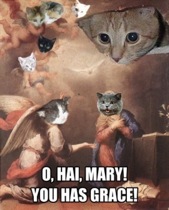
					<b>Nate: </b><em>“So: what exactly are the cultural meanings and implications of the collective internet effort to paraphrase the entire Bible in the language of <a href="http://en.wikipedia.org/wiki/Lolcat">LOLCats</a>? Bad taste bordering on sacrilege? A mockery of the care and exceeding effort of the many people working to make the Bible available to every person in their mother tongue? Or something that in its way might actually border on the reverent? Certainly we see the collective efforts of lots of people contemplating the meaning of verse after verse, even if only at first to look for hilarious potential misspellings and mysterious cheezburger refrains.”</em><br />		
		<div style="float:right; padding:15px 5px 5px 5px"><img src="http://culture-making.com/media/OHAIMARY_210.jpg" alt="image"></div><p>Mary sed &#8220;Ceiling Cat is laik a big deal,
Mai I is happy about Ceiling Cat&#8230;
bcz he kepted me in maind an now evribodi knowz i can haz cheezburgr.
Thank u Ceiling Cat, u iz cool.
U iz niec to evribodi.
Xcept peeplz who doant dizrv it LOL.
U haz pwned teh r00lrz
whiel stil bein niec to teh n00bz.
U givd cookies to teh hungri
whiel u tolded teh rich &#8220;Niec trai.&#8221;
U wuz niec to Israel
an to all Abraham&#8217;s famili liek u promist.&#8221;</p><hr />
<div class="author" style="font-size: -1">Luke 1:46–56, <a href="http://www.lolcatbible.com/index.php?title=Luke_1#46">LOLCat Bible Translation Project</a> :: thanks Christine!</div>		


      ]]></content>
    </entry>


</feed>