
]]>
Nate
: ?Performance artist Laurie Anderson on the importance of getting outside your own identity. I love her three-tiered description of how she sees the world.?In 2002 you were NASA’s first artist in residence, Why you?
Because I have a reputation for being a gear head and a wire head. It was a really great gig. I went to mission control in Pasadena, and I met the guy who figures out how to color the stars in the photos taken by the Hubble Space Telescope.
The opportunity came about completely out of the blue, as many things are in my life. Somebody called and said “Do you want to be the first artist in residence at NASA?” and I said “What does that mean in a space program?” and they said “ Well, we don’t know what that means. What does it mean to you?” I was like “Who are you people? What does it mean to me? What are you talking about?”
You’ve also worked at McDonald’s.
Yeah. I began to think, “How can I escape this trap of just experiencing what I expect?” I decided maybe I would just try to put myself in places where I don’t know what to do, what to say, or how to act. So, I did things like working at McDonald’s and on an Amish farm, which had no technology whatsoever.
What do you need to “escape” from?
At heart, I’m an anthropologist. I try to jump out of my skin. I normally see the world as an artist first, second as a New Yorker and third as a woman. That’s a perspective that I sometimes would like to escape. It’s why in my performances I use audio filters to change my voice. That’s a way to escape as well.
—Culture Making, p.44
]]>The police fired water cannons and tear gas to disperse hundreds of people who forced their way into shuttered shops in the southern city of Concepción, which was devastated. But law enforcement authorities, heeding the cries of residents that they lacked food and water, eventually settled on a system that allowed staples to be taken but not televisions and other electronic goods.

In colonial Nigeria in the last years of the 19th century, a strange quirk of history led the British rulers to draw an arbitrary boundary line along the 7?10? N line of latitude, separating the population into two separate administrative districts.
Below the line, the colonial government raised money by levying taxes on imported alcohol and other goods that came through Southern Protectorate’s sea ports. Above the line, the administrators of the landlocked Northern Protectorate had no sea ports, and instead raised money through direct taxes. In the areas near the border, this took the form of a simple poll tax, where tax officials collected from each citizen the equivalent of between $4 and $20 in today’s dollars.
Could this seemingly minor difference—created over a century ago by a long-defunct colonial administration, and long ago erased by subsequent administrative divisions—possibly still matter today?
Yes, it could, according to Daniel Berger, a PhD student in politics at NYU. Berger’s paper, Taxes, Institutions and Local Governance: Evidence from a Natural Experiment in Colonial Nigeria, finds that the “simple act of having to collect taxes caused governments to be forced to build the capacity which can now provide basic government services.” As a result, governance today is “significantly better” in areas just above the line than in those just below it.
Reflections of Generosity: Fort Drum Arts and Crafts Center
August 19 - September 11
The “Reflections of Generosity – Toward Restoration and Peace” Art Exhibit is dedicated to the memory of the heroes of 9-11 and the Soldiers who have given their lives in recent conflicts. Experience the power of painting, sculpture, and song to facilitate restoration through generosity, community, and beauty. Join us at Arts and Crafts for artwork and performances that reflect the spirit of ongoing generosity demonstrated by the military. The opening night will feature Makoto Fujimura, Tim Sheesley, Pamela Moore, Sharon Graham Sargent, Claye Noch, Joyce Lee, Sandra Ceas, Jay Walker, Gerda Liebmann, C. Robin Janning, Craig Hawkins, John Russel, Charles A. Westfall Macon, Ron Kelsey, Kyla Kelsey, Christa Wells, and Christy Tennant.
]]>A deep problem is the replacement, in the medical profession as in the legal profession, of a professional model of service with a business model. In the professional model, the service provider is assured a good but not extravagant income by limitations on competition, and in exchange he is expected to avoid exploiting the ignorance of patients as he could do by performing unnecessary or low-value procedures. In the business model, the service provider endeavors to maximize his net revenues. In the case of medicine, the disparity of knowledge between provider and patient, coupled with the fear and desperation that serious illness (or just the possibility of it) engenders, enables the profit-maximizing provider often to convince the patient to undergo costly low-value treatments. Certainly the profit-maximizing health-care provider will be very relucant to refuse to provide a treatment that the patient insists upon, his insistence being made convincing by the fact that insurance will pay all or most of the cost. Insurers do try to limit their costs by refusing to approve low-value procedures—but in the face of combined pressure by provider and patient, the insurer is often forced to back down.
To return to the initial puzzle of why our peer nations are able to provide what seems, judging by outcomes, a level of health equal or superior to that of Americans at far lower cost, the only convincing answer is that the health-care providers in those nations limit treatment. I am not sure of the explanation, but the possibilities include: the professional model is more tenacious in societies less committed to free markets and a commercial culture than the United States; more of their hospitals are public and more of their doctors are public employees, who are therefore salaried rather than entrepreneurial; and Americans, being less fatalistic than most other peoples, have a more intense demand for life-extending procedures.
When it comes to illicit media, the agents for good and evil, even outside New York, are always symbiotic: pornography, in the experience of many moral crusaders, is like an infuriating weed that loves nothing more than a good pesticide, its strength only enhanced by efforts to tamp it down. But Long also chronicles the way that initiatives to eradicate vice only helped pave the way for its further evolution in the city. Try to eliminate drinking on Sunday by limiting it to hotels, as did the Raines Law of 1896, and suddenly every bar and saloon in Manhattan is putting up cheap dividers to create makeshift accommodations, ideal breeding grounds for prostitution, which thrived in the era of the so-called Raines Law hotels. Try to provide a place where working-class men can find a bathroom that isn’t in a bar, and from that solution — public restrooms — will come another challenge: gay (semipublic) sex.
Andy
: ?McSweeney's is best known for subtly self-aware singer-songwriter-style low-key comedy, but here is a perfectly straightforward yet strangely impressive interview with a 911 dispatcher. Now that's a cultural good that has reshaped our world in beneficial ways. One of its few problematic consequences: thanks to American media, 911 is so widely known around the world that people in other countries often dial that number even when their country's emergency number is completely different.?Q: You sound like you’re able to handle the ups and downs of this job pretty well.
A: I think the key to doing this job, in addition to multitasking and speed of movement, is to be able to handle the emotional components. I’m good at it; I’m empathetic and I don’t take it home at the end of the day. I can talk about things like domestic violence; it’s just a reality.
Q: How long have you been doing this job?
A: I’ve been doing it for nine years. My job now is training supervisor, so I manage ongoing training. New trainees go through a nine-month process; we have an academy. They learn call-taking, radio dispatching, the medical aspect, interpersonal skills.
And you have to know geography. Geography is so important, because people can call and have no clue where they are.
Nate
: ?The Indian capital bans plastic bags—just like San Francisco, except the regulation seems to be a lot further-reaching (besides covering millions more residents). Evidently Rwanda, Bhutan, and Bangladesh already have similar laws.?Carry a plastic bag in Delhi and you could be imprisoned for five years. Officials in India’s capital have decided that the only way to stem the rising tide of polythene is to outlaw the plastic shopping bag.
According to the official note, the “use, storage and sale” of plastic bags of any kind or thickness will be banned. The new guideline means that customers, shopkeepers, hoteliers and hospital staff face a 100,000 rupee fine (£1,370) and a possible jail sentence for using non-biodegradable bags….
Civil servants said that punitive measures were needed after a law prohibiting all but the thinnest plastic bags – no thicker than 0.04mm – was ignored.
Although the government had originally concluded that plastic bags were too cheap and convenient to be disposed of, the authorities appear to have been swayed by environmentalists who pointed out that used bags were clogging drains and so providing breeding grounds for malaria and dengue fever. There is evidence that prohibition of plastic bags can work. Countries such as Rwanda, Bhutan and Bangladesh have all had bans enforced.
Nate
: ?After studying at an Anglican university in Hong Kong and then becoming the first East Asian to be admitted as a barrister in England, Wu Tingfang served as the Qing Dynasty's minister to the United States, Spain, and Peru around the turn of the last century. His 1914 book comparing American and Chinese cultures is a fascinating, moving, and at times amusing read; it was written in part to counter the era's entrenched discrimination against Chinese immigrants. I particularly enjoyed his bafflement at the Americans' boast of calling their president, simply, "Mr."; he argues (in a playful but serious manner) for a more exalted title.?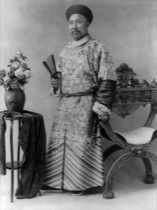
[T]here are railroad kings, copper kings, tobacco kings, etc. It is, however, manifestly improper and incongruous that the people should possess a higher title than their President, who is the head of the nation. To make it even, I would suggest that the title “President” be changed to “Emperor,” for the following reasons: First, it would not only do away with the impropriety of the chief magistrate of the nation assuming a name below that of some of his people, but it would place him on a level with the highest ruler of any nation on the face of the earth. I have often heard the remark that the President of the United States is no more than a common citizen, elected for four years, and that on the expiration of his term he reverts to his former humble status of a private citizen; that he has nothing in common with the dignified majesty of an Emperor; but were the highest official of the United States to be in future officially known as Emperor, all these depreciatory remarks would fall to the ground. There is no reason whatever why he should not be so styled, as, by virtue of his high office, he possesses almost as much power as the most aristocratic ruler of any nation. Secondly, it would clearly demonstrate the sovereign power of the people; a people who could make and unmake an Emperor, would certainly be highly respected. Thirdly, the United States sends ambassadors to Germany, Austria, Russia, etc. According to international law, ambassadors have what is called the representative character, that is, they represent their sovereign by whom they are delegated, and are entitled to the same honors to which their constituent would be entitled were he personally present. In a Republic where the head of the State is only a citizen and the sovereign is the people, it is only by a stretch of imagination that its ambassador can be said to represent the person of his sovereign. Now it would be much more in consonance with the dignified character of an American ambassador to be the representative of an Emperor than of a simple President. The name of Emperor may be distasteful to some, but may not a new meaning be given to it?
Nate
: ?Here's a way of fighting hunger and obesity at the same time, by incentivising (or perhaps just enabling) healthier food choices for those on public assistance. But I wonder how many people who'd like to take advantage of such a program would actually have a farmer's market they could easily get to? And there's the issue that, if you're poor and your job, time, and home situations are less stable, canned goods and fast food may be (as noted earlier) a better fit for your short-term needs.?
In the 2008 farm bill, Congress allocated $20 million for a pilot program to explore how to create incentives to purchase fruits, vegetables or other healthful foods in order to improve the diets of food stamp recipients and potentially reduce obesity. Several nonprofit groups and foundations are experimenting with similar incentives.
One is the Wholesome Wave Foundation, an organization that works to make locally grown food more widely available. In the spring, it launched a program that doubles the value of food stamps and fruit and vegetable vouchers of low-income mothers and seniors who use them at farmers markets in Connecticut, Massachusetts and California.The Wholesome Wave matching grants were an instant hit at the City Heights market in San Diego. On the first day that matching funds became available, sales using government-issued electronic benefit cards soared by more than 200 percent. In subsequent weeks, the line to receive matching vouchers formed at 7:30 a.m., and the available funds were exhausted by 9:30 a.m., just 30 minutes after the market opened.
“We’re not taking away your benefits because you spend them on Twinkies,” said Michel Nischan, a Connecticut chef and president of Wholesome Wave. “But if you decide you want to spend it on fresh tomatoes, you’ll get double your money.”
Nate
: ?The output of the 1930s Federal Writers Project, especially some of the oral histories, looks pretty interesting.?Journalism | While we’re on the subject of a New New Deal, an unemployed newsman says, how about resurrecting F.D.R.’s Federal Writers Project to tide over all the laid-off journalists displaced by the turmoil in their industry? They could chronicle “the ground-level impact of the Great Recession” or the transition to a green economy. And who knows? There might be a Steinbeck, Terkel or Ellison among them too. [New Republic]
]]>Andy
: ?One of the only benefits of horrific attacks like last week's terrorism in India is the opportunity they give societies to honestly assess their own horizons of possibility and impossibility. This commentary by the University of Chicago's Dipesh Chakrabarty is a good example. One can only hope against hope that India's response is more effective than our own country's after 11 September 2001, which, as the years go by, seems more and more to me to have truly missed the best opportunities for change—most of all in our hardened attitudes towards immigrants and even simply students and visitors from the majority of the world.?To have an effective cordon sanitaire against terror would require India to inject a degree of efficiency, alertness, and performance into an administrative apparatus that simply has not delivered on these scores for decades. For many interesting historical reasons (that need not detain us here), government and public institutions in India gradually ceased to be effective deliverers of goods and services, beginning in the 1970’s. There is much that democracy in India has achieved, including the famous overturning of the autocratic Emergency Rule that Mrs. Gandhi once imposed and the sense of participation many low-caste communities have in the country’s governmental institutions. But democracy in India has also become predominantly a means of electoral empowerment of different groups—low-castes, dalits, minorities, or even majoritarian Hindus who claim to have been “weakened” by the “privileges” accorded to minorities.
The growth of this politics of identity has made elections into the mainstay of Indian democracy. It has distanced politics from issues of governance, and has gone hand in hand with a deepening degree of corruption, financial and otherwise, on the part of politicians and officials. A large number of the elected members of parliament have criminal cases pending against them, and media reports suggest an elephantine, unaccountable, inefficient bureaucracy mired in the self-indulgent use of resources (corruption and inefficiency often going together). There was, as last week’s events made clear, no effective coast guard force on the Indian seas, in spite of the government having been warned of possible terror attacks on Mumbai from the sea. When the Taj Hotel caught fire, it took the first lot of firefighters three hours to respond. The commando force had to be dispatched from Delhi and it took about nine hours to mobilize them, as they are usually kept busy providing “security” to politicians, many of whom see such security as a matter of status and prestige.
Andy
: ?I might cavil with some of the presuppositions in this article. Is the presidency, or any other role in a political system constructed of checks and balances, really very much like Tolkien's "One Ring to rule them all"? Does not the free market tend to generate its own loci of unchecked power? What is the author's position on the ultimate expression of "government social engineering," namely warfare? Still, this is a compelling summary of an important argument that cannot be simply waved away. And in a moment when it is very possible that one political party will command a supermajority beginning in January, it may be all too timely.?It is no longer shameful to lust after power so long as one lusts for the good of the people. In the words of Boromir, speaking of the One Ring, “For you seem to think of its power only in the hands of the enemy: of its evil uses not of its good.” The only rejoinder, in Frodo’s words to Boromir, is that “we cannot use it, and what is done with it turns to evil.” Yes, it’s that simple. And as you ascend the levels of authority, from city to state to nation, it only becomes more true.
There are several reasons. One, already alluded to, is the corruption of power. No matter for what noble ends power may be sought, at some point it always becomes an end in itself, and then the jig is up . . . but the power and its abuses live on. This is why even the most flagrantly failed government programs are nearly impossible to kill.
Another reason that centralized government social engineering simply doesn’t work is what F.A. Hayek called “the knowledge problem.” Hayek was the only Austrian economist ever to win a Nobel Prize. He won it partly for a brief essay called “The Use of Knowledge in Society,” in which he explained that government is intrinsically helpless before most social and economic problems because the knowledge needed to solve them is too widely dispersed among the members of society. It cannot ever be made known in a timely fashion to a central authority, and even if it could, that authority would lack the godlike coordinating ability needed to use that knowledge effectively. Adding to the difficulty, much of this knowledge is tacit knowledge, not consciously known or articulated by the individuals who have it.
What can make effective use of the knowledge distributed locally among the members of society? Only the free market system and its accompanying structure of voluntary trades and changing prices. Freely determined market prices are what send signals to individuals telling them how to best use their unique knowledge to their own, and ultimately society’s, advantage. Without a free market, the only way to allocate resources is by government fiat–a few, far-removed individuals making choices for us all, perhaps with the best of intentions but in near-total ignorance.
—Abraham Lincoln, 1858, via Richard John Neuhaus
]]>Andy
: ?David Heim reviews Shelby Steele's new book about Obama, A Bound Man, and offers this intriguing thought on the limits of "authenticity" as a test for political leadership. Politics may be the realm where attention to the actual, concrete cultural goods produced, rather than vague appeals to values or identity, is most necessary—worth remembering as the fall presidential campaign moves into high gear.?Steele’s deepest worries about Obama are not about his political chances but about his personal authenticity. Whether as bargainer or challenger or some creative mix of the two, Steele thinks, a black leader must don a mask, forging a persona that will charm or manipulate whites. In taking on this task, Steele contends, black leaders lose themselves, for they are never able to locate what they themselves really think. Steele wonders: Is Obama running for president because of his deep convictions or simply because he is aware of “his power to enthrall whites”?
But questions of authenticity can be raised about every politician. The peculiar job of a politician is to fashion repeatedly points of agreement between people with different and shifting points of view and to project a public persona that can elicit action and be the vehicle for people’s hopes. If personal authenticity is your quest, politics is the wrong medium. We can wish for congruence between the inner and the outer person of the politician, but in the end what matters for the voters is the direction of the policies chosen and the decisions made.
Nate
: ?Cell phones are a transformative technology all over the world, but in different ways in different regions. In Africa, the newfound possibility of rapid communication and reporting makes it a lot easier to track—and prevent—election mischief.?The humble mobile phone is driving a new revolution which some experts hope could bring fairer elections and democracy to some African states. Many African countries have struggled against rigged elections and authoritarian rule since gaining independence last century.
However, African observers say the growth of simple communication technologies like cell phones are assisting many states to progress towards open and fair elections in increasingly democratic systems. Senegal is one of a number of African countries to hold successful elections by keeping voting and counting in check through independent communication.
Former United Nations Secretary-General Kofi Annan said many African nations now had a “very open society” and the increasing success of elections owed a lot to the existence of mobile phones. “With communication and cell phones, this is where it is difficult to cheat in elections now. You are announced at the district level and cell phones go wild so by the time you go to the capital, if you have changed the figures, they will know and you will be caught out.”
Nate
: ?I happend on this interesting chain of cultural implications encompassed within a couple blocks in downtown Lubbock: if you swivel to the right from this view you'll see: bail bonds, jail, Sheriff's department, courthouse, bus transit plaza, bail bonds. All of these represent different interdependent cultural spheres.?Nate
: ?Sometimes the medium does transcend the message. My friend Koranteng notes that the dictatorship of Mobutu Sese Seko stands out among evil regimes for having produced a body of self-serving propaganda that people actually liked, even outside the country and after the fact: lots of very excellent sokous tunes. From the dispatch below, it sounds like the national tradition of ignoring the lyrics is alive and well.?A French aid worker in Congo, Cabiau admits that he has trouble telling Werrason apart from Wazekwa, but that he’s “developed a taste for this joyous cacaphony.”
Lorsque les décibels s’affolent, impossible de rester assis. Si l’on se donne la peine de s’aventurer sur la piste, au milieu des miroirs et des déhanchements endiablés, on ne peut que succomber. On est alors entraîné dans des chorégraphies délirantes que tout bon kinois connaît sur le bout des doigts. C’est le feu. De la folie furieuse. C’est Kinshasa.
When the decibels reach a panic, it’s impossible to stay seated. If make the effort to get out there on the dance floor, among the mirrors and the frenzy of swaying hips, you cannot help but give in. You are led out into wild dance moves that every good kinois knows at the edge of his fingertips. It’s on fire. It’s madness. It’s Kinshasa.
Cabiau also writes about the phenomenon of “libanga.” Libanga is to Congolese music what product placement is to American film and television. For a few thousand dollars, “a company, a brand of beer, a politicians, or an officer in the army” can see his name placed in a song. Several dozen such paid shoutouts might be in a single song. “Curiously, that doesn’t seem to bother many people,” Cabiau writes.