<?xml version="1.0" encoding="utf-8"?>
<feed xmlns="http://www.w3.org/2005/Atom" xml:lang="en">

    <title type="text">Culture Making items tagged design</title>
    <subtitle type="text">Culture Making:Main column content</subtitle>
    <link rel="alternate" type="text/html" href="http://www.culture-making.com/author/" />
    <link rel="self" type="application/atom+xml" href="http://www.culture-making.com/tag/atom/" />
    <updated>2009-01-07T20:43:49Z</updated>
    <rights>Copyright (c) 2009, Nate Barksdale</rights>
    <generator uri="http://www.pmachine.com/" version="1.6.4">ExpressionEngine</generator>
    <id>tag:culture-making.com,2009:01:07</id>


    <entry>
      <title>Objectified</title>
      <link rel="alternate" type="text/html" href="http://www.culture-making.com/post/objectified/" />
      <id>tag:culture-making.com,2009:author/9.1204</id>
      <published>2009-01-07T15:43:49Z</published>
      <updated>2009-01-07T20:43:49Z</updated>
      <author>
            <name>Nate Barksdale</name>
            <email>natebarksdale@gmail.com</email>
                  </author>

      <content type="html"><![CDATA[


			<p><object width="420" height="340" style="margin: auto"><param name="movie" value="http://www.youtube.com/v/S9E2D2PaIcI&amp;color1=0xb1b1b1&amp;color2=0xcfcfcf&amp;feature=player_embedded&amp;fs=1"></param><param name="allowFullScreen" value="true"></param><embed src="http://www.youtube.com/v/S9E2D2PaIcI&amp;color1=0xb1b1b1&amp;color2=0xcfcfcf&amp;feature=player_embedded&amp;fs=1" type="application/x-shockwave-flash" allowfullscreen="true" width="425" height="344"></embed></object>
</p><br />
<b>Andy: </b><em>“Filmmaker Gary Hustwit's most celebrated work is <a href="http://www.helveticafilm.com/">Helvetica,</a> a documentary film about, yes, the typeface. His new project, <a href="http://www.objectifiedfilm.com/">Objectified,</a> looks very promising. I couldn't help noticing that all the voices, and very nearly all the designers pictured, were male . . . perhaps because the "objects" chosen as salient were mostly technological devices. It will be interesting to see how broadly the final film explores the range of objects that actually shape our horizons.”</em><br /><hr /><span style="font-size: -1">from "<a href="http://www.objectifiedfilm.com/objectified-trailer-quicktime/">Objectified: A Documentary Film by Gary Hustwit</a>," 5 January 2009 :: via <a href="http://daringfireball.net">Daring Fireball</a></span>


      ]]></content>
    </entry>

    <entry>
      <title>Making of a chair</title>
      <link rel="alternate" type="text/html" href="http://www.culture-making.com/post/making_of_a_chair/" />
      <id>tag:culture-making.com,2009:author/9.1146</id>
      <published>2009-01-07T15:43:49Z</published>
      <updated>2009-01-07T20:43:49Z</updated>
      <author>
            <name>Nate Barksdale</name>
            <email>natebarksdale@gmail.com</email>
                  </author>

      <content type="html"><![CDATA[


			<p align="center"><embed src="http://services.brightcove.com/services/viewer/federated_f8/1316333565" bgcolor="#FFFFFF" flashVars="videoId=1586418314&amp;playerId=1316333565&amp;viewerSecureGatewayURL=https://console.brightcove.com/services/amfgateway&amp;servicesURL=http://services.brightcove.com/services&amp;cdnURL=http://admin.brightcove.com&amp;domain=embed&amp;autoStart=false&amp;" base="http://admin.brightcove.com" name="flashObj" width="420" height="356" seamlesstabbing="false" type="application/x-shockwave-flash" swLiveConnect="true" pluginspage="http://www.macromedia.com/shockwave/download/index.cgi?P1_Prod_Version=ShockwaveFlash"></embed>
<br />

</p><br />
<b>Andy: </b><em>“This (longish) video on the making of Eames fiberglass chairs circa 1970 is striking for its juxtaposition of tools and techniques that range from the quintessentially modern to the surprisingly old-fashioned (to the alarming—I don't think you're supposed to handle fiberglass with your bare hands!). And for the unbearably 1970s flute soundtrack. And for the chairs themselves, still cool and cozy after all these years.”</em><br /><hr /><span style="font-size: -1">from "<a href="http://blog.robustflavor.com/2008/11/18/the-shell-chair-by-charles-eames">The Shell Chair by Charles Eames</a>," <a href="http://blog.robustflavor.com/">Robust Flavor</a>, 18 November 2008 :: via <a href="http://www.37signals.com/svn/">37 Signals</a> via <a href="http://www.coudal.com/">Coudal</a> ad infinitum</span>


      ]]></content>
    </entry>

    <entry>
      <title>Baby on board</title>
      <link rel="alternate" type="text/html" href="http://www.culture-making.com/post/baby_on_board/" />
      <id>tag:culture-making.com,2009:author/9.1140</id>
      <published>2009-01-07T15:43:49Z</published>
      <updated>2009-01-07T20:43:49Z</updated>
      <author>
            <name>Nate Barksdale</name>
            <email>natebarksdale@gmail.com</email>
                  </author>

      <content type="html"><![CDATA[


					<b>Nate: </b><em>“Here's an innovative approach to creating lifesaving medical equipment that can work well (and be repaired) in conditions often found in the developing world. The article, I suppose in <i>New York Times</i> fashion, complicates the issue with quotes from doubtful experts who have their own, largely behavioral programs for reducing infant mortality. It's heartbreaking that it's presented as a one-or-the-other sort of choice.”</em><br />		
		<div style="float:right; padding:15px 5px 5px 5px"><img src="http://culture-making.com/media/16incubator_190_210.jpg" alt="image"></div><p>In truth, experts say, the developing world doesn’t need more incubators. It needs incubators that work. Over the years, thousands have been donated from rich nations, only to end up in “incubator graveyards” — most broken, some never opened. According to a 2007 study from Duke University, 96 percent of foreign-donated medical equipment fails within five years of donation — mostly because of electrical problems, like voltage surges or brownouts or broken knobs, or because of training problems, like neglecting to send user manuals along with the devices.</p><p>To compensate for this philanthropic shortsightedness, medical staffs either crank up the temperature in “incubator rooms” to 100 degrees or more, or swaddle babies in plastic to hold in body heat. Such makeshift solutions led the Boston team to ask: How can we make an incubator for the developing world that will get fixed? . . .</p><p>In his discussions with doctors who practice in impoverished settings, Dr. Rosen learned that no matter how remote the locale, there always seemed to be a Toyota 4Runner in working order. It was his “Aha!” moment, he recalled later: Why not make the incubator out of new or used car parts, and teach local auto mechanics to be medical technologists?
<br />

</p><hr />
<div class="author" style="font-size: -1">from "<a href="http://www.nytimes.com/2008/12/16/health/16incubators.html">Looking Under the Hood and Seeing an Incubator</a>," by Madeline Drexler, <a href="http://www.nytimes.com/2008/12/16/health/16incubators.html">NYTimes.com</a>, 15 December 2008</div>		


      ]]></content>
    </entry>

    <entry>
      <title>Remember (I was torn between), by Jay Kelly</title>
      <link rel="alternate" type="text/html" href="http://www.culture-making.com/post/remember_i_was_torn_between_by_jay_kelly/" />
      <id>tag:culture-making.com,2009:author/9.1091</id>
      <published>2009-01-07T15:43:49Z</published>
      <updated>2009-01-07T20:43:49Z</updated>
      <author>
            <name>Nate Barksdale</name>
            <email>natebarksdale@gmail.com</email>
                  </author>

      <content type="html"><![CDATA[


					<b>Nate: </b><em>“Southern California artist Jay Kelly's collages are arresting and uplifting, messy and beautiful, painterly and graphic designer-ish—and just the slightest bit repetitive (looking at a whole year's work on one of his <a href="http://www.jkfineart.com/gallery2008.html">gallery pages</a> feels a bit like perusing the motivational artwork at the offices of the world's coolest corporation). But one or two at a time, they're really something.”</em><br />		
		<a href="http://www.jkfineart.com/"><img src="http://culture-making.com/media/2008-Remember-pop.jpg" alt="image" /></a><hr />
<div class="author" style="font-size: -1">"Remember (I was torn between)" 2008, collage, acrylic and resin on wood panel, by <a href="http://www.jkfineart.com/">Jay Kelly</a> :: via <a href="http://www.dailyserving.com/2008/11/jay_kelly.php">DailyServing.com</a></div>		


      ]]></content>
    </entry>

    <entry>
      <title>Cheaper than a bottle of coke</title>
      <link rel="alternate" type="text/html" href="http://www.culture-making.com/post/cheaper_than_a_bottle_of_coke/" />
      <id>tag:culture-making.com,2009:author/9.1048</id>
      <published>2009-01-07T15:43:49Z</published>
      <updated>2009-01-07T20:43:49Z</updated>
      <author>
            <name>Nate Barksdale</name>
            <email>natebarksdale@gmail.com</email>
                  </author>

      <content type="html"><![CDATA[


					<b>Nate: </b><em>“"The world's most popular chair"—this one with murkier, more recent origins than the venerable Thonet Model No.14. Still, when Bruce Cockburn sings about his visit to a Mozambique village, "They stuck me in the only chair they had / while the cooked cassava and a luckless hen," there's no doubt which sort of seat he's talking about.”</em><br />		
		<div style="float:right; padding:15px 5px 5px 5px"><img src="http://culture-making.com/media/Plastic-Chair_210.jpg" alt="image"></div><p>Maybe you’re sitting on one right now. It has a high back with slats, or arches, or a fan of leaf blades, or some intricate tracery. Its legs are wide and splayed, not solid. The plastic in the seat is three-sixteenths of an inch thick. It’s probably white, though possibly green. Maybe you like how handy it is, how you can stack it or leave it outdoors and not worry about it. Maybe you’re pleased that it cost less than a bottle of shampoo.</p><p>No matter what you’re doing, millions of other people around the world are likely sitting right now on a single-piece, jointless, all-plastic, all-weather, inexpensive, molded stacking chair. It may be the most popular chair in history.</p><p>That dawned on me recently after I started noticing The Chair in news photographs from global trouble spots. In a town on the West Bank, an indignant Yasser Arafat holds a broken chair damaged by an Israeli military operation. In Nigeria, contestants in a Miss World pageant are seated demurely on plastic chairs just before riots break out, killing some 200 people. In Baghdad, U.S. administrator L. Paul Bremer III, during a ceremony honoring Iraqi recruits, sits on a white plastic chair as if on a throne....</p><p>The plastic chairs in all those places were essentially alike, as far as I could tell, and seemed to be a natural part of the scene, whatever it was. It occurred to me that this humble piece of furniture, criticized by some people as hopelessly tacky, was an item of truly international, even universal, utility. What other product in recent history has been so widely, so to speak, embraced? And how had it found niches in so many different societies and at so many different levels, from posh resorts to dirt courtyards? How did it gain a global foothold?
</p><hr />
<div class="author" style="font-size: -1">from "<a href="http://www.smithsonianmag.com/people-places/seat.html?c=y&page=1">Everybody Take A Seat</a>," by Mariana Gosnell, <a href="http://www.smithsonianmag.com/people-places/seat.html?c=y&page=1"><i>Smithsonian</i></a>, July 2004 :: image via <a href="http://neetaexports.tradeindia.com/Exporters_Suppliers/Exporter12938.186559/Plastic-Chair.html">Neeta Exports</a></div>		


      ]]></content>
    </entry>

    <entry>
      <title>Cheaper than a bottle of wine</title>
      <link rel="alternate" type="text/html" href="http://www.culture-making.com/post/cheaper_than_a_bottle_of_wine/" />
      <id>tag:culture-making.com,2009:author/9.1039</id>
      <published>2009-01-07T15:43:49Z</published>
      <updated>2009-01-07T20:43:49Z</updated>
      <author>
            <name>Nate Barksdale</name>
            <email>natebarksdale@gmail.com</email>
                  </author>

      <content type="html"><![CDATA[


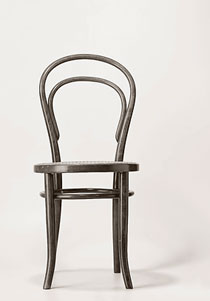
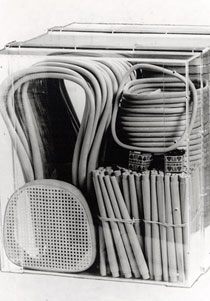
					<b>Nate: </b><em>“"The world's most popular chair" turns 150.”</em><br />		
		<div style="float:right; padding:15px 5px 5px 5px"><img src="http://culture-making.com/media/thonet14_210.jpg" alt="image"><img src="http://culture-making.com/media/cube_210.jpg" alt="image"></div><p>It consists of six pieces of wood - two circles, two sticks and a couple of arches - held together by 10 screws and two nuts. Together they make the wooden chair known as Thonet Model No.14, which although no one has ever actually done the math, is thought to have seated more people than any other chair in history.</p><p>The No.14 was the result of years of technical experiments by its inventor, the 19th-century German-born cabinetmaker Michael Thonet. His ambition was characteristically bold. Thonet wanted to produce the first mass-manufactured chair, which would be sold at an affordable price (three florins, slightly less than a bottle of wine).
</p><hr />
<div class="author" style="font-size: -1">from "<a href="http://www.iht.com/articles/2008/11/10/style/design10.php?page=1">No. 14: The chair that has seated millions</a>," by Alice Rawsthorn, <a href="http://www.iht.com/articles/2008/11/10/style/design10.php?page=1"><i>International Herald Tribune</i></a>, 7 November 2008</div>		


      ]]></content>
    </entry>

    <entry>
      <title>The paper wins</title>
      <link rel="alternate" type="text/html" href="http://www.culture-making.com/post/the_paper_wins/" />
      <id>tag:culture-making.com,2009:author/9.1012</id>
      <published>2009-01-07T15:43:49Z</published>
      <updated>2009-01-07T20:43:49Z</updated>
      <author>
            <name>Nate Barksdale</name>
            <email>natebarksdale@gmail.com</email>
                  </author>

      <content type="html"><![CDATA[


			<b>Andy: </b><em>“I've expressed my admiration before for John Maeda, the president of the Rhode Island School of Design. But I think my admiration just went up another notch, upon the discovery that he carries this 18-year-old academic paper (literally, on paper) by Pixar's John Lasseter with him wherever he goes. The excerpts from the paper he links to are well worth reading. And I love the photo, with a sheet of paper in the background containing, over and over, the handwritten words, <i>"raison d'être."</i> Three cheers.”</em><br />
<div class="author" style="font-size: -1">from "<a href="http://our.risd.edu/2008/11/04/my-favorite-research-paper/">My Favorite Research Paper</a>," by John Maeda, <a href="http://our.risd.edu/">Our (and Your) RISD</a>, 4 November 2008</div><hr />		
		<p class="img"><img src="http://www.culture-making.com/media/pixar_420.jpg" alt="pixar.jpg"></p>
<p>I have carried a reprint of John Lasseter’s seminal paper on computer animation, “Principles of Traditional Animation Applied to 3D Computer Animation,” for the last 18 years. This hardcopy document has been to Japan, both coasts of the US, and has really been near/dear to me and is yellowed from age and embarassingly food-stained and so forth. It occurred to me today that maybe this paper might be available online, and I just found it in excerpted form <a href="http://www.siggraph.org/education/materials/HyperGraph/animation/character_animation/principles/prin_trad_anim.htm">here</a>. I’m not sure what to call it … but maybe I had a kind of myopia when it came to this one document in my life. I felt that unless I held onto it in print, that I would never be able to handily access the information. Discovering that the content is available online right now seems truly freeing to me. And yet oddly enough, I am still hesitant to place my tattered reprint into my recycling box before I leave to my next engagement this evening. </p><p>There’s always the “just in case” when it comes to any information around you. Even in this digital era we know it’s easy to lose information forever. Nothing is truly permanent. But I’ve carried this paper around for 18 years — hmmmm, as old as an RISD freshman. Ah. The power of perspective. Looks like this paper will be sticking around me for many more years to come. Dilemma resolved. Paper wins.
</p>


      ]]></content>
    </entry>

    <entry>
      <title>Articles of good design</title>
      <link rel="alternate" type="text/html" href="http://www.culture-making.com/post/articles_of_good_design/" />
      <id>tag:culture-making.com,2009:author/9.997</id>
      <published>2009-01-07T15:43:49Z</published>
      <updated>2009-01-07T20:43:49Z</updated>
      <author>
            <name>Nate Barksdale</name>
            <email>natebarksdale@gmail.com</email>
                  </author>

      <content type="html"><![CDATA[


					<b>Nate: </b><em>“A page from the 1927 edition of Samuel Welo's 233-page <i>Studio Handbook</i>, a type and design book in which every page was hand-lettered by Welo. Many of the pages remind me of dialogue cards from silent films, which makes sense given the era. The whole handlettered aesthetic, though, also brings to mind a line from book-cover-designer Chip Kidd in which he and another designer agree something to the effect of "Computers and graphics software are wonderful tools, but no designer should be allowed to use then before age 40."”</em><br />		
		<a href="http://www.creativepro.com/blog/scanning-around-with-gene-the-best-type-book-with-no-typesetting?page=0,1"><img src="http://culture-making.com/media/20080822SAWG_fg29.jpg" alt="image" /></a><hr />
<div class="author" style="font-size: -1">from "<a href="http://www.creativepro.com/blog/scanning-around-with-gene-the-best-type-book-with-no-typesetting?page=0,1">The Best Type Book with No Typesetting</a>," by Gene Gable, <a href="http://www.creativepro.com/blog/scanning-around-with-gene-the-best-type-book-with-no-typesetting?page=0,1"> CreativePro.com</a>, 21 August 2008 :: via <a href="http://www.xplane.com/xblog/2008/10/28/the-best-type-book-with-no-typesetting/">xBlog</a></div>		


      ]]></content>
    </entry>

    <entry>
      <title>Babar, Arthur and Celeste</title>
      <link rel="alternate" type="text/html" href="http://www.culture-making.com/post/babar_arthur_and_celeste/" />
      <id>tag:culture-making.com,2009:author/9.881</id>
      <published>2009-01-07T15:43:49Z</published>
      <updated>2009-01-07T20:43:49Z</updated>
      <author>
            <name>Nate Barksdale</name>
            <email>natebarksdale@gmail.com</email>
                  </author>

      <content type="html"><![CDATA[


					<b>Nate: </b><em>“It's hard to imagine a more simplified Babar than the one I know from the books, but here you go, from the author's book of preliminary sketches. This page's text translation: "Babar hurries to take Arthur and Celeste to the big store and buys them some fine clothes."”</em><br />		
		<a href="http://www.themorgan.org/collections/swf/exhibOnline.asp?id=915"><img src="http://culture-making.com/media/Picture-4.jpg" alt="image" /></a><hr />
<div class="author" style="font-size: -1">from "<a href="http://www.themorgan.org/collections/swf/exhibOnline.asp?id=915">Jean de Brunhoff's <i>Histoire de Babar Maquette</i></a>," pp. 20-21, <a href="http://www.themorgan.org/collections/swf/exhibOnline.asp?id=915">The Morgan Library & Museum Online Exhibitions</a> :: via <a href="http://www.newyorker.com/reporting/2008/09/22/080922fa_fact_gopnik"><i>The New Yorker</i></a></div>		


      ]]></content>
    </entry>

    <entry>
      <title>Thinking is making, and making is thinking</title>
      <link rel="alternate" type="text/html" href="http://www.culture-making.com/post/thinking_is_making_and_making_is_thinking/" />
      <id>tag:culture-making.com,2009:author/9.855</id>
      <published>2009-01-07T15:43:49Z</published>
      <updated>2009-01-07T20:43:49Z</updated>
      <author>
            <name>Nate Barksdale</name>
            <email>natebarksdale@gmail.com</email>
                  </author>

      <content type="html"><![CDATA[


			<b>Andy: </b><em>“Lovely exhortation to his students and colleagues from the newly installed president of the Rhode Island School of Design. Don't you wish your college president posted blog entries like this?”</em><br />
<div class="author" style="font-size: -1">from "<a href="http://our.risd.edu/2008/09/17/thinking-is-making-and-making-is-thinking/">Thinking is Making, and Making is Thinking</a>," by John Maeda, <a href="http://our.risd.edu/">Our (and Your) RISD</a>, 17 September 2008</div><hr />		
		<p style="margin-left: auto; margin-right: auto; width: 420px"><img src="http://www.culture-making.com/media/maeda_grass.jpg" alt="hand holding a grass sculpture" /></p><p>In the moments when I can attend one of my children’s soccer games, I find great pleasure from sitting in a field of grass. Since I was a child I have been making little sculptures out of blades of grass … as I did so just this last weekend during a match. Coming off of the <a href="http://our.risd.edu/start-here/">inauguration,</a> it made me think of our Provost Jessie Shefrin’s phrase, “Thinking is a kind of making, and making is a kind of thinking.” I make. Therefore, I think. I hope you make something interesting today.
</p>


      ]]></content>
    </entry>

    <entry>
      <title>Fig Leaf Wardrobe, by Tord Boontje</title>
      <link rel="alternate" type="text/html" href="http://www.culture-making.com/post/fig_leaf_wardrobe_by_tord_boontje/" />
      <id>tag:culture-making.com,2009:author/9.806</id>
      <published>2009-01-07T15:43:49Z</published>
      <updated>2009-01-07T20:43:49Z</updated>
      <author>
            <name>Nate Barksdale</name>
            <email>natebarksdale@gmail.com</email>
                  </author>

      <content type="html"><![CDATA[


					<b>Nate: </b><em>“Here's a witty if not-super-practical Dutch furniture designer's play on the first post-Fall human cultural product. In this case it's the fig tree's own nakedness that's being covered up.”</em><br />		
		<a href="http://mocoloco.com/archives/005493.php"><img src="http://culture-making.com/media/fig-cabinet_tord_boontje.jpg" alt="image" /></a><hr />
<div class="author" style="font-size: -1">Fig Leaf Wardrobe, by <a href="http://www.tordboontje.com/">Tord Boontje</a> for <a href="http://www.madebymeta.com/pages/products.html">Meta</a>, Copper, enamel, bronze, and hand-dyed silk :: via <a href="http://mocoloco.com/archives/005493.php">MoCo Loco</a></div>		


      ]]></content>
    </entry>

    <entry>
      <title>Post&#45;digital at the Rhode Island School of Design</title>
      <link rel="alternate" type="text/html" href="http://www.culture-making.com/post/post_digital_at_the_rhode_island_school_of_design/" />
      <id>tag:culture-making.com,2009:author/9.795</id>
      <published>2009-01-07T15:43:49Z</published>
      <updated>2009-01-07T20:43:49Z</updated>
      <author>
            <name>Nate Barksdale</name>
            <email>natebarksdale@gmail.com</email>
                  </author>

      <content type="html"><![CDATA[


					<b>Andy: </b><em>“John Maeda has just left a professorship at the prestigious MIT Media Lab to become president of the Rhode Island School of Design. As he says at the end of this fascinating and important interview, "I've already been digital. I want to focus on being human."”</em><br />		
		<p>A RISD education is classical and rigorous; first-year students are required to practice the fundamentals of drawing and sculpture. Foundation Studies are taught in rooms filled to the ceilings with thousands of skeletons, taxidermy, minerals, reptiles, birds. (A sign warns “The doves are out so please close the door.") Other departments cover everything from photography to ceramics. The curriculum is so conservative as to be radical.</p><p>Some of RISD’s studios probably haven’t changed in a hundred years. The stuff of art and design is everywhere, in the charcoal dust, the heaps of wet clay, the scraps of wood. A RISD education focuses on what you can do with your hands; an architecture student is expected to be able to draw, a print-maker to use a press. . . .</p><p>“A designer is someone who constructs while he thinks, someone for whom planning and making go together,” says Mr. Maeda, cocking his head, widening his eyes, moving his hands as if he were shaping a pot. Mr. Maeda considers himself post-digital; he has outgrown his fascination with hardware and is driven by ideas. “I want to reform technology. All the tools are the same; people make the same things with them. Everyone asks me, ‘Are you bringing technology to RISD?’ I tell them, no, I’m bringing RISD to technology.” He describes a visit to the campus by an executive from Yahoo. Mr. Maeda took him to see the visual resources center in the new library. Hundreds of thousands of drawings, photographs and news clippings, and images of art, architecture and decorative arts—on slides—are cataloged and stored in old-fashioned metal and wood file cabinets. The Yahoo executive was stunned. “This is a real live Google!” Better, says Mr. Maeda.
</p><hr />
<div class="author" style="font-size: -1">from "<a href="http://online.wsj.com/article/SB122031259187688831.html">A Cultural Conversation with John Maeda</a>," by Dominique Browning, <a href="http://online.wsj.com/">WSJ.com</a>, 2 September 2008 <i>(Non-subscribers can access this article through 9 September 2008 <a href="http://www.emailthis.clickability.com/et/emailThis?clickMap=viewThis&etMailToID=2032241669">here</a>)</i></div>		


      ]]></content>
    </entry>

    <entry>
      <title>Keep noticing!</title>
      <link rel="alternate" type="text/html" href="http://www.culture-making.com/post/keep_noticing/" />
      <id>tag:culture-making.com,2009:author/9.771</id>
      <published>2009-01-07T15:43:49Z</published>
      <updated>2009-01-07T20:43:49Z</updated>
      <author>
            <name>Nate Barksdale</name>
            <email>natebarksdale@gmail.com</email>
                  </author>

      <content type="html"><![CDATA[


					<b>Nate: </b><em>“Two design consultants offer simple ideas for how to cultivate the discipline of noticing—which, of course, is such a foundational skill for our big and small efforts to create and cultivate (and, for that matter, just enjoy) culture.”</em><br />		
		<p><b>Soltzberg</b>: So given that there are all these patterns and themes around us, yet being adept at noticing requires practice, how can people sharpen their noticing “chops?”</p><p><b>Portigal:</b> I’ve assigned students to routinely maintain a noticing log, either a blog (words with pictures) or a Flickr account (pictures with words). The exercise helps sharpen noticing skills by giving people permission to simply observe and document. There’s never any requirement to suggest a fix; indeed what they observe may not be broken in any way. It just has to arouse their interest, and in documenting it make the details of that interest explicit. Establishing some discipline for this behavior can be very helpful.</p><p><b>Soltzberg:</b> Sometimes I do an exercise with workshop groups, which works in a similar way. Everyone takes a turn describing something they saw or experienced between the time they got up and the present moment; something that they haven’t talked about with anyone that day. It could be something unusual or something really mundane—just a quick description with maybe one or two details. People are always surprised when they realize how many things they are actually experiencing but not really noticing. It’s such a simple activity, but people have told me later on that they felt much more awake after doing it.</p><p><b>Portigal:</b> That’s a good place to be solving problems from. Well, let’s get out there and keep noticing.
<br />

</p><hr />
<div class="author" style="font-size: -1">from "<a href="http://www.aiga.org/content.cfm/ever-notice">Ever Notice?</a>," by Steve Portigal and Dan Soltzberg, <a href="http://www.aiga.org/content.cfm/ever-notice"><i>AIGA Journal of Business and Design</i></a>, 18 July 2008 :: via <a href="http://www.kottke.org/08/08/supernoticing">kottke.org</a></div>		


      ]]></content>
    </entry>

    <entry>
      <title>Smash Song Hits by Rodgers &amp;amp; Hart, by Alex Steinweis</title>
      <link rel="alternate" type="text/html" href="http://www.culture-making.com/post/smash_song_hits_by_rodgers_hart_by_alex_steinweis/" />
      <id>tag:culture-making.com,2009:author/9.499</id>
      <published>2009-01-07T15:43:49Z</published>
      <updated>2009-01-07T20:43:49Z</updated>
      <author>
            <name>Nate Barksdale</name>
            <email>natebarksdale@gmail.com</email>
                  </author>

      <content type="html"><![CDATA[


					<b>Nate: </b><em>“Apparently this is the world's first album cover. Before this records came in generic paper sleeves. It's actually far less boring than I'd expect the first album cover to have been.”</em><br />		
		<a href="http://www.undependent.com/blog/2008/01/13/the-worlds-first-album-cover-alex-steinweiss-greatest-hit/"><img src="http://horizonsofthepossible.com/media/coversquare_thumb.jpg" alt="image" /></a><hr />
<div class="author" style="font-size: -1"><i>Smash Song Hits,</i> cover design by Alex Steinweiss for Columbia Records, 1938, scan posted by <a href="http://www.undependent.com/blog/2008/01/13/the-worlds-first-album-cover-alex-steinweiss-greatest-hit/">Undependant</a> :: via <a href="http://www.kottke.org/remainder/08/07/15981.html">kottke</a></div>		


      ]]></content>
    </entry>


</feed>