Posts tagged art
 Good art in dark times

If what’s always distinguished bad writing—flat characters, a narrative world that’s cliched and not recognizably human, etc.—is also a description of today’s world, then bad writing becomes an ingenious mimesis of a bad world. If readers simply believe the world is stupid and shallow and mean, then Ellis can write a mean shallow stupid novel that becomes a mordant deadpan commentary on the badness of everything. Look man, we’d probably most of us agree that these are dark times, and stupid ones, but do we need fiction that does nothing but dramatize how dark and stupid everything is? In dark times, the definition of good art would seem to be art that locates and applies CPR to those elements of what’s human and magical that still live and glow despite the times’ darkness. Really good fiction could have as dark a worldview as it wished, but it’d find a way both to depict this world and to illuminate the possibilities for being alive and human in it.


 Tastes great, but is it art?
Nate
: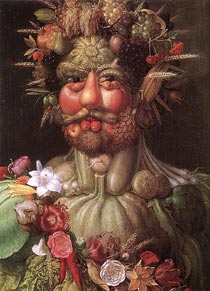
What issues might we be thinking about in trying to decide whether to classify cooking as one of the arts? Here are some.
1) Is the person who says of the Chateau Petrus they have just tasted that it is a work of art to be taken literally?
2) Is the experience we have of a Beethoven String Quartet sufficiently different from that we have when eating a great meal so that we should distinguish them as different kinds of experience?
3) Does it make sense to say of someone that they have been moved by a meal?
4) Is it significant for classifying something as an art form that a meal is consumed in the process of appreciation?
5) When I say of Grant Achatz that he is an artist in the kitchen how does this differ from saying he is a genius at the stove?
6) Why do we distinguish between the architect who designed Notre Dame and those who built it by designating the latter as craftsmen and the former as an artist? Is there a class bias exhibited by this distinction?
7) A piece of music can express sadness. A pate cannot. So?
 Leaves and teeth
 Petroglyphs
Nate
:
It’s interesting to see that although people appreciate their very rich culture, they do not connect its traditions to contemporary knowledge and practices. For example, students in the graphic design course I taught at ENAV asked me to give them lessons in color, insisting they knew nothing about it. This really surprised me. My immediate answer was, “But you should teach me! You’re surrounded by color and use it in such powerful ways in every aspect of daily life. I admire you for it!” Their response was to laugh and say, “But Teacher! That’s not design! We need to use design colors.” From talking to my students and people in the cultural sector, I got the impression that design was this distant, quite artificial, field they had to adapt to. Their main concern is learning software.
It creates no wealth or goods
A characteristic of play, in fact, is that it creates no wealth or goods, thus differing from work or art. At the end of the game, all can and must start over again at the same point. Nothing has been harvested or manufactured, no masterpiece has been created, no capital has accrued. Play is an occasion of pure waste: waste of time, energy, ingenuity, skill, and often of money ... As for the professionals—the boxers, cyclists, jockeys, or actors who earn their living in the ring, track, or hippodrome or on the stage, and who must think in terms of prize, salary, or title—it is clear that they are not players but workers. When they play it is at some other game.
 Religious art for nonbelievers
This is not simply to say that all religious expressions are artistic. But what religious symbols can do, more powerfully than any other, is reveal a horizon of meaning towards which art aspires: the ability to make ontological claims about “the way things really are”. To come back to some philosophical language from Gadamer, religious symbols perfect the “intricate interplay of showing and concealing”. And among other things, it seems to be this tantalising capacity that has kept modern artists, even those with no doctrinal connection to Christianity, returning to fundamental religious images like the crucifixion.
For the non-believer, perhaps focusing on this “poetical teaching” can offer a way of engaging with religious art in a manner beyond merely cultural or aesthetic appreciation; one which begins to dance, albeit gingerly, along the perimeters of the theological. What we experience in religious art, ultimately, doesn’t have to lead us into heaven. In Botticini’s “Assumption”, the disciples gather around Mary’s tomb, only to discover an assortment of lilies has taken the place where her body should rest. Uncomprehending, they look around in bewilderment. If looking at religious art can leave us similarly stunned, perhaps for some that’s more than miracle enough.


 The gift of non-order

Perhaps the most striking thing of all about the vision of the new heaven and earth at the end of Revelation is that it is indeed new. This is worth probing and pondering carefully. It is new in the sense we have already spoken about: the created world is not returned to its beginning but (like the risen body of Christ) elevated to a fresh level. But it is surely “new” in another sense also—it is ever new. In the world to come, nothing ever becomes old, and since it is hard to imagine this as a static state of perfection (if time and movement, as part of God’s creation, are taken up in the new heaven and earth), we must surely speak of endless and surprising novelty as belonging to the new creation. We dare to envisage the Holy Spirit weaving limitless, unpredictable improvisations out of the “givens” of creation, doubtless to the delight of us all.
What needs subverting here is the common assumption that there are only two possible basic shapes to our lives—order and disorder. Order is considered good and fruitful—disorder evil and damaging. If our house is immaculate, we are complimented; if it looks like bedlam, we apologize. But are order and disorder the only options? What about laughter? It is not order (predictably patterned) but nor is it disorder (destructive). It is an example of what Daniel Hardy and David Ford call “non-order,” or the “jazz-factor.” . . .
[One] of the reasons artists and pastors need each other is to learn and relearn together that the richest fruit comes from the interplay between order and non-order, between the given chords and the improvised riff, between the faithful bass of God’s grace and the novel whirls of the Spirit. The question for pastors, then, is: Are you prepared to allow artists room to provoke the church to venture into risky arenas of novelty—a fresh “take” on a parable, a hitherto unexplored zone of culture? The question for artists is: Are you prepared to get to know the “bass lines” of artistic tradition, and, more fundamentally, the bass lines that God uses to hold his church in the faith?
The farmer–pastor
[My relationships with artists] have been messy and, at times, unpleasant. I’ve struggled with patience, expected too much, pushed too far, and overstretched my own small spool of energies. But the use of a gentle, consistent hand is, despite my stumbling, effective. Why? Because the arts are made by people for people—each as intricate and organic as the corn my grandfather raised. In this very human endeavor, I have to continually remind myself that the arts are not buttons we push to enhance a sermon. They’re not levers we switch to intensify an evangelistic tactic. Art has to do with people we love, and this love bears witness to Christ. . . .
As farmer-pastors, we are lovers. We tenderly work the soil of our culture by identifying artistic gifts with discernment (pastoring). Then our joyful response to discovering the artists is to push their gifts outward in order to share their creativity with others (promoting). Finally, we prune the gifts and coach the artists to mature so that their fruit will be sustainable and long lasting (producing). . . .
How can the gospel find a vibrant witness through the arts to transform our neighborhoods and cities? We must begin with a renewal of our churches before we have anything to offer the culture outside the church. And we begin this renewal not by asking what the arts can do for the church, to vary on John F. Kennedy’s dictum, but how the church can serve the arts. As patient, careful stewards, we, as pastors and leaders, can nourish the soil of our culture by the way we love artists intentionally—loving not only their artwork, but who they are as persons in the process.
 The coolest reindeer
In my experience, artistic talent shows up early. I’m very leery of forty-eight-year-olds who come to me and say, “I think I’m going to become a writer.” I always want to say to them, “And I think I’m going to have an IQ of 237.” It’s not about deciding what talent you have. You either have it, or you don’t.
I was in my seven-year-old nephew’s second-grade class around Christmastime. Looking up on the wall, it was immediately obvious to me which of the little blokes had talent because some of the things on the wall looked like blobs and some looked like reindeer. Not only that, but some kids had put the reindeer in a setting with foreground, while others had them frolicking in the snow. That is, some of the kids were already playing with composition.
I asked my little nephew and his two best friends, Matt and Allen, “Who is the best artist in your class?” And they replied with one refrain: “Joey. Joey can draw.”
Don’t you wish we could do that in the church? Simply accept the self-evident truth that this kid can draw, and that one can sing, and that one is good at dancing? There is something beautiful in the way kids accept the divine economy, which doles out graces and talent so arbitrarily. It’s dreadfully uncivil of God to make us grownups so uncomfortable by giving some kids artistic talents and others none at all.
So, if you want to be a patron of the arts, go into the second grade of your local grammar school, find out whoever produced the coolest reindeer, and then patronize that kid.
Beautify the commandments
The Jewish communities of my childhood taught me, among other things, about art. Specifically, Judaism taught me the principle of hiddur mitzvah. This is the idea that one does not just do the commandments, one “beautifies” them. The roots of this commandment may be found in Exodus 15:2, which may be translated something like: “This is my God and I will beautify him with praises.” In a passage of the Talmud (Masechet Shabbat 133b), the rabbis muse over this verse: What exactly does it mean to “beautify” God? How does one “beautify God with praises”? The rabbis have an answer: “Adorn yourself before him by a truly elegant fulfillment of the religious duties, for example a beautiful tabernacle, a beautiful palm branch, a beautiful ram’s horn, beautiful show fringes, a beautiful scroll or the Torah, written in fine ink, with a fine reed, by a skilled penman, wrapped with beautiful silks.”
In other words, when you fulfill the commandment to blow a shofar, a ram’s horn, during the liturgies for Rosh Hashanah and Yom Kippur, don’t blow just any old ram’s horn—beautify the commandment by using a beautiful shofar. And when you build and take your meals in a sukkah, a hut, during the festival of Sukkot, do not just throw up a shack whose dimensions happen to meet your requirements, but build a beautiful tabernacle in which to take your holiday meals. . . . This is the theological sensibility that prompted those seventeenth- and eighteenth-century eastern European Jews to craft intricate marriage contracts, turning simple legal documents into objects of art. Those papercutters knew that a man pledging to treat his soon-to-be wife fairly and honorably was more than just the faithful discharging of a commandment. It was an opportunity to “adorn”—glorify—God.