Posts tagged architecture
 Tastes great, but is it art?
Nate
:

What issues might we be thinking about in trying to decide whether to classify cooking as one of the arts? Here are some.
1) Is the person who says of the Chateau Petrus they have just tasted that it is a work of art to be taken literally?
2) Is the experience we have of a Beethoven String Quartet sufficiently different from that we have when eating a great meal so that we should distinguish them as different kinds of experience?
3) Does it make sense to say of someone that they have been moved by a meal?
4) Is it significant for classifying something as an art form that a meal is consumed in the process of appreciation?
5) When I say of Grant Achatz that he is an artist in the kitchen how does this differ from saying he is a genius at the stove?
6) Why do we distinguish between the architect who designed Notre Dame and those who built it by designating the latter as craftsmen and the former as an artist? Is there a class bias exhibited by this distinction?
7) A piece of music can express sadness. A pate cannot. So?


 Cleaning a cool house

Ms. Acedo [the housekeeper who must clean Rem Koolhaas’s Lemoîne house in Bordeaux, France] is a star, a woman of determination, ingenuity and forthright opinions who can match anything the house throws at her. As the film starts, she stands on the platform surrounded by her pails, mops, brooms, rags and vacuum cleaner while it rises slowly to the strains of a romantic Strauss melody. (Actually, she does not use the platform, preferring the arduous stair route ever since she got stuck between floors and a technician had to crawl through the books to reach the controls.)
She even succeeds in confounding the notoriously self-possessed architect, in his recorded 10-minute response to the film. One sequence shows her aggressive cleaning of one of the house’s most offputting features, a punitive spiral stair consisting only of toe holds in a round concrete void open to the rain, unfazed by the seeming impossibility of dragging a vacuum up it. Mr. Koolhaas is momentarily flummoxed by the irreconcilability of his architecture and her cleaning methods.
But only momentarily. He quickly redefines the subject as the collision of two systems—“the platonic conception of cleaning and the platonic idea of architecture”—which I take to be the consideration of each on an elevated abstract plane of theoretical existence. Anyone who has ever done any cleaning knows that is not where it lives.
Let us concede the point: It is clear that the job is being pursued with familiar and archaic methods and devices that seem surreally unrelated to the task at hand, revealing how out of sync the vision—no matter how beautifully executed—and the result can be.
There are no televisions here
The idea of a city of books evokes a fantastical vision: towers of tottering volumes, narrow alleys formed by canyons and stacks of dusty hardbacks, formal avenues between loaded shelves. Like something imagined by Calvino or Borges, it conjures up a city of wisdom and surprise, of endless narratives, meaning, knowledge and languages. What it does not evoke is an industrial estate bounded by a motorway and the heavily guarded edge of a demilitarised zone. Yet somehow, South Korea’s Paju Book City begins to reconcile these two extremes into one of the most unexpected and remarkable architectural endeavours.
Built on marshland, former flood plains and paddyfields 30km north-west of Seoul, Paju Book City is an attempt to create an ambitious new town based exclusively around publishing….
At the centre of the city stands a huge cultural complex, designed by Kim Byung-yoon, a combination of hotel (in which, it was pointed out to me, there are no TVs), restaurants, auditoriums and, on the roof, an urbane, elevated realm of seating, shops, libraries and galleries overlooking the sparkling waters of the river and the Simhak Mountain.
 “Dispatchwork” in Berlin
 The Saddlebackplex

The correspondences between the Googleplex and Saddleback are remarkable: Rigid building models were broken down into amorphous, disaggregated masses, screened from their parking lots by trees and artificial hills; both campuses include plush lounges, landscaped paths, beach-volleyball courts, and cafés (with “outdoor seating for sunshine daydreaming,” Google’s website boasts). The architecture is meant to persuade church members or secular employees—especially younger people—to spend their most productive time there. As Google CEO Eric Schmidt has said, “knowledge workers believe they are paid to be effective, not to work 9 to 5.”
It’s no coincidence that Saddleback mirrors the top office environments of its day. Warren was a good friend of [Peter] Drucker’s (the consultant died in 2005), and the books he has written for pastors quote Drucker liberally. Drucker, in turn, was so impressed with the business acumen of evangelical leaders that in 1998 he declared the megachurch “surely the most important social phenomenon in American society in the last 30 years.”
Making the stairs more inviting
So how does one design a building where people actually use the stairs? There are three key features.
1) Fewer turns between the stairs and the closest entrance.
2) Stairs with large surface areas (not too narrow and steep).
3) Create a view, either up, down, or across, from the stairwell. No one wants to walk up a tiny, white box.
The Booth School of Business staircases meet all of these requirements (perhaps it’s no surprise the building won a major design award last year). For those who can’t build new stairwells, there are a few other nudges to try. Displaying motivational signs in the lobby and throughout the building, and playing music in the stairwell can increase stair use. Together, these two nudges can increase usage by as much as 9 percent. Hanging artwork on the stairwell walls, closing elevators occasionally, and offering incentives like fruit are also known to work.
Artist Liz Glynn and her assistants built a small model of Rome in a day from cardboard and wood at New York’s New Museum. And then destroyed it.
 Slums are the answer
Nate
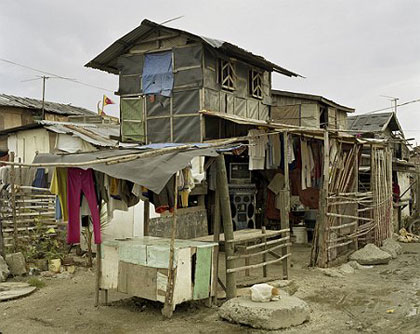
:To be sure, there is something unseemly in privileged people rhapsodizing about such places. Prince Charles, for all his praise, does not appear poised to move to a shack in Dharavi. Identifying the positive aspects of poverty risks glorifying it or rationalizing it. Moreover, some of the qualities extolled by analysts are direct results of deprivation. Low resource consumption may be good for the earth, but it is not the residents’ choice. Most proponents of this thinking agree that it’s crucial to address the conflict between improving standards of living and preserving the benefits of shantytowns.
But given the reality that poverty exists and seems unlikely to disappear soon, squatter cities can also be seen as a remarkably successful response to adversity - more successful, in fact, than the alternatives governments have tried to devise over the years. They also represent the future. An estimated 1 billion people now live in them, a number that is projected to double by 2030. The global urban population recently exceeded the rural for the first time, and the majority of that growth has occurred in slums. According to Stewart Brand, founder of the Long Now Foundation and author of the forthcoming book “Whole Earth Discipline,” which covers these issues, “It’s a clear-eyed, direct view we’re calling for - neither romanticizing squatter cities or regarding them as a pestilence. These things are more solution than problem.”

Nate
: Steeling their courage
Nate
:
Nate
:Crosstown crosswords
Nate
: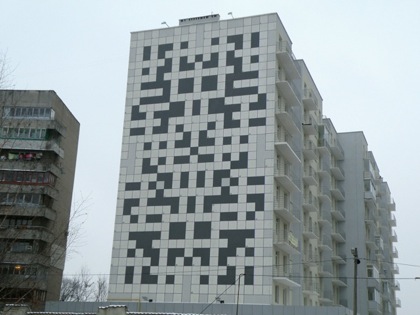
People of Lvov city in Ukraine decided to add another attraction for the visitors of their city. According to the artistic project it was decided to place a giant 100 feet (30 meters) tall at the wall of the one of the multi-stored residential houses.
There is one interesting detail about the design of the puzzle. It looks like an empty puzzle during the day-light, but at night when special lights are on the words in the puzzle become visible with a lightly-glowing fluorescent color.
The questions for this crossword puzzle are located in different point of interests of the city, like monuments, theaters, fountains etc. So people while walking around the city can try to answer the questions and writing down the answers. When the night comes to the city they can meet at this house and check their degree of intelligence.

Nate
:Boxes of worship
Nate
:
The challenges of repurposing big-box stores are not limited to dealing with their unwieldy size. Often, the real estate can be tied up in complicated arrangements. The potential buyer of a big-box store might encounter any number of stipulations on what the building, parking lot, and land can be used for in the future. These stipulations can make it difficult for other businesses to move into an abandoned big-box—but they also open up such spaces for more creative use. The Calvary Chapel in Pinellas Park, Fla., purchased an abandoned Wal-Mart building across the street from its previous home. The deed specified that the structure could not be used by one of Wal-Mart’s various competitors for several decades. But for the moment, at least, churches aren’t on that list. Many former big-box stores have been reclaimed by civic institutions—a library, a courthouse—and by churches. Before moving into this old Wal-Mart, the Calvary Chapel had made its home in an abandoned Winn-Dixie grocery store across the highway.
The teardown may represent a kind of progress: the new house is superior in nearly every technological way to the building it replaced. But it also represents a kind of cultural failure—the failure to make something of the world that was given to the owners of that piece of property. Such failure is sometimes inevitable—the world we must make something of includes, for better or worse, the economic realities of the real estate markets and the construction business, the unwise and slipshod architectural choices of previous generations, and laws governing land use that impose relatively stiff taxes on small buildings. But while the responsibility for the cultural failure that is a teardown may be shared by many parties, it is a failure still.
—Culture Making, p.55

Nate
:Architecture as anthill madness
Nate
:
The Tower of Babel is a vision of architecture as anthill madness. As the British Museum’s exhibition Babylon: Myth and Reality reveals, Brueghel is not the only artist driven to imagine this fabulous building. Towers of Babel proliferate in this show, be they painted with miniaturist precision or exploding in apocalyptic doom; there’s even one made of shoes, in a 2001 painting by Michael Lassel. Martin van Heemskerk’s, however, is square, in keeping with old sources he studied, but his attempt to visualise what the tower was “really” like does not stop him showing its top smashed apart by divine lightning. In an anonymous Dutch painting—one of a series that riff on Brueghel—the city that surrounds the tower is on fire, the summit of the hubristic edifice menaced by an eerie light coming through the storm clouds. Perhaps the strangest is by Athanasius Kircher, a 17th-century scholar whose light, airy spiral looks prophetically modern, like a blueprint for a skyscraper.
Arabesques

Nate
: