


The United Nations Environment Program has just launched this Google map-enabled site with before/after satellite images showing environmental change over the past few decades: cities grow, forests are converted to farmland, glaciers shrink. We’re making something of the world, both for better and for worse.
Posts tagged agriculture
excerpt  Strawberries and reindeer
Strawberries and reindeer
From an interstitial essay in a wonderful book of portraits and reportage examining what foods "typical" families from around the world eat in the course of a week.
Nate
:
Cooking is universal among our species. Cooking is even more uniquely characteristic of our species than language. Animals do at least bark, roar, chirp, do at least signal by sound; only we bake, boil, roast and fry….
Few advances comparable in importance to cooking have happened since [its development]. The most important have been more quantitative than qualitative. We began not simply to harvest but to adopt certain palatable plants and animals as aids and conspirators. By 3,000 to 4,000 years ago, we had domesticated all those that have been central to our diets ever sense—barley, wheat, rice, maize, potatoes, sheep, goats, cattle, horses, and so on…. We have domesticated nothing more significant than strawberries and reindeer since.
excerpt The daily grind
The daily grind
To make tortillas the traditional way, first you have to cook the maize with something alkaline (cement, for instance), and then grind the wet grains by hand, kneeling on the floor with your metate. It takes about an hour to grind enough to feed one person for one day. Until fifty years ago, there was no effective widespread way to automate this process: every Mexican household would have one woman in the back room, grinding wet corn for five hours a day. Since then, things have changed—bringing great benefits, widespread social change, and some losses too.
Nate:
Of course, there are trade-offs. Bimbo is not as good as a bolillo. A machine-made tortilla is not anything like a homemade tortilla – it’s not even in the same universe.
Mexican women that I have talked to are very explicit about this trade-off. They know it doesn’t taste as good; they don’t care. Because if they want to have time, if they want to work, if they want to send their kids to school, then taste is less important than having that bit of extra money, and moving into the middle class. They have very self-consciously made this decision. In the last ten years, the number of women working in Mexico has gone up from about thirty-three percent to nearly fifty percent. One reason for that—it’s not the only reason, but it is a very important reason—is that we’ve had a revolution in the processing of maize for tortillas.
"Obsessives: Seeds," by Leslie Jonath, Eric Slatkin, Blake Smith, and Roxanne Webber, CHOW, 29 April 2010 :: via Coudal Partners
An interview with Jeremiah "Jere" Gettle, founder of Baker County Heirloom Seeds, on the joys of seed-saving, -sharing, and of course -cultivating. Filmed in the company's "seed bank" storefront, the converted historic Sonoma County National Bank Building.
Nate: 
From an essay on the culture and history of dirt-eating, often undertaken by pregnant women (presumably craving specific needed minerals), but until recently surprisingly widespread. "In the 1970s, fifty percent of Black women admitted to eating clay, about four times the frequency among white women ..." I like the idea outlined below, of sniffing the soil and then tasting produce grown in it.
Nate:
People living in San Francisco can find a soil tasting in a nearby art gallery; the rest of us can e-participate through a website (tasteofplace.info) run by performance artist and “agricultural activist” Laura Parker. Parker strives to answer the question “how does soil touch our lives and affect our food; and why does it matter?” To stimulate public dialogue, Parker fills wine goblets with various soils and adds a few teaspoons of water to release the aromas and flavors. The soils aren’t ingested, but participants place their noses deep into the wine bowls, inhaling the newly released molecules to the backs of their tongues, where taste receptors lie. The website even provides “Tasting Notes,” such as the soil of “Apple Farm-Indian Camp Ground, ‘Arrowhead Reserve,’” which has a “texture like ground espresso between your fingertips with a rich, chocolate color. The nose is both flinty and grassy with finesse and subtlety.” After the soil tasting, participants dine on food grown in the various soils and identify the qualities of the dirt in the food to strengthen the connection between what we eat and where it’s grown.
excerpt Marginalia
Marginalia
This year I've joined a reading group at my church; last Sunday the book was an old collection of Wendell Berry's influential agrarian essays. My eleven-year-old nephew sat in on our discussion (he'd read a couple of the essays in preparation), and asked a question that gets to the well-worn stumbling block when it comes to Berry's bracing jeremiads: "But what if I want to be a computer programmer and not a farmer?" There are ways of answering that within the text, but not always satisfyingly. For me, the passage I loved most from the book was this one, the grace-note ending to Berry's essay on wilderness.
Nate:
Looking at the monocultures of industrial civilization, we yearn with a kind of homesickness for the humanness and the naturalness of a highly diversified, multipurpose landscape, democratically divided, with many margins. The margins are of the utmost importance. They are the divisions between holdings, as well as between kinds of work and kinds of land. These margins—lanes, streamsides, wooded fencerows, and the like—are always freeholds of wildness, where limits are set on human intention. Such places are hospitable to the wild lives of plants and animals and the wild play of human children. They enact, within the bounds of human domesticity itself, a human courtesy towards the world that is one of the best safeguards of designated tracts of true wilderness.
excerpt Another one bites the dust
Another one bites the dust
Dirt-eating is fascinating and, one must admit, kind of disturbing. It calls to mind strange associations—of little kids who experience the world by putting it in their mouth; of the pregnant heroine in Barbara Kingsolver's The Poisonwood Bible who craves dirt for its needed nutrients; of parrots flocking at clay banks for their own dietary supplement, of the American slaves described in historien Eugene Genovese's Roll Jordan Roll, who swallowed dirt in response to their dire conditions—and, more happily, of the farmer sampling his soil to discern how best to tend it.
Nate:
“It used to be,” writes William Bryant Logan in Dirt, “that a good farmer could tell a lot about his soil by rolling a lump of it around in his mouth.” Today, apparently, it is harder to find someone who literally eats dirt:
Not in Texas, nor Vermont, nor Kentucky, nor California, nor western New York. Everybody knew somebody who once did it, but nobody could quite remember the name of the fellow.
Finally, Logan came across Bill Wolf, an organic pioneer who started his environmental research under Buckminster Fuller and who used to eat soil, until his doctor forbade him.
Soil contains bad bugs as well as good ones, and the physician did not want to have to sort them out in Wolf’s guts. But back in the days when he chawed, Bill could tell acid from alkaline by the fizz of the soil in his mouth.
A very acid soil would crackle like those sour candies that kids eat, and it had the sharp taste of a citrus drink. A neutral soil didn’t fizz and it had the odour and flavour of the soil’s humus, caused by little creatures called “actinomycetes.” An alkaline soil tasted chalky and coated the tongue.
Having conducted this simple taste test, Logan explains, farmers could apply calcium carbonate to the Sprite-flavoured fizzy soil and gypsum to the Milk of Magnesia tongue-coating soil, which would then “react with the hydrogen of acid clays and the sodium of salt-clays, respectively,” in order to re-balance the soil’s pH and improve its structure.
A fascinating detail from one of the many good, inspiring, and challenging obituaries of the Green Revolution's pioneering crop scientist, Norman Borlaug. The Economist's obit is also full of lovely details.
Nate:
In 1953, Dr. Borlaug began working with a wheat strain containing an unusual gene. It had the effect of shrinking the wheat plant, creating a stubby, compact variety. Yet crucially, the seed heads did not shrink, meaning a small plant could still produce a large amount of wheat.
Dr. Borlaug and his team transferred the gene into tropical wheats. When high fertilizer levels were applied to these new “semidwarf” plants, the results were nothing short of astonishing. The plants would produce enormous heads of grain, yet their stiff, short bodies could support the weight without falling over. On the same amount of land, wheat output could be tripled or quadrupled. Later, the idea was applied to rice, the staple crop for nearly half the world’s population, with yields jumping several-fold compared with some traditional varieties. This strange principle of increasing yields by shrinking plants was the central insight of the Green Revolution, and its impact was enormous.
Is technology a moral obligation?
Nate:
I know the Amish, and Wendell Berry and Eric Brende, and the minimites well enough to know that they believe we don’t need exploding technology to expand ourselves, at least in the proper directions. They are, after all, minimalists. They see most of the promises of freedoms from increased technology as illusionary. In their eyes, technology generates fake choices, meaningless options, or real choices that are really entrapments. This is an argument worth exploring because there is some truth in it. The technium is an autonomous system that tends to favor choices by humans that expand its own reach, which can feel like a type of entrapment. And many choices we make don’t matter.
But the evidence that the technium expands real choices is voluminous. Throughout history there is a one-way march from the farm to the bustling choices of the city. That steady migration is going on today at a shocking rate; More than two million people per day decide they prefer the options that modern technology life offers, so they flee the constrained choices in a picturesque and comforting village somewhere. They can’t all be bewitched. It would be a powerful spell to fool 50% of the people living on this planet.
Those million urban migrants per day have enrolled into the technium for the same reason you have (and you have if you are reading this): to increase your choices. To increase your chances of unleashing your full potential. Perhaps someday someone will invent a tool that is made just for your special combination of hidden talents. Or perhaps you will make your own tool. Most importantly, and unlike the Amish and minimites, you may invent a tool which will help unleash the fullest of someone else. Our call is not only to discover our fullest selves in the technium, but to expand the possibilities for others. We have a moral obligation to increase the amount of technology in the world in order to increase the number of possibilities for the most people. Greater technology will selfishly unleash us, but it will also unselfishly unleash others, our children and all to come.
Google Street View
I liked that these giant tractor tires are both the product this garage sells and services, and the roadside sign advertising said product. The medium is the message! Meanwhile, my local correspondent adds: "I've been told by others that we should try to have service done here when possible (there's another tire/auto place in town) because this is the one that services tractor and big truck tires, so if they go out of business, it would be very difficult for locals to get their tractor tires serviced."
Nate
:
excerpt Between common and professional
Between common and professional
Here's one of my all-time favorite teachers, writing about the strong (and slightly counterintuitive) role of tradition in the novel and world-changing reshaping of the North American landscape by European colonists.
Nate
:Agriculturalists have long distrusted miners, millers, and other proponents of manufacturing; in a land where once nine of every ten people worked in agriculture, it is not surprising that much of our national heritage subtly emphasizes the good life of husbandry and the beauty and rightness of space shaped for farming. Equally significant in American culture is the tension between common and professional builders; while well-read men who understood the new theories of geography, mercantile capitalism, representative government, and innovative design sometimes directed colonization, people much less literate and far more traditional actually shaped the land. Very few cartographers and surveyors and spatial theorists migrated to the New World; men like William Penn were as rare as his finely drawn plan for Philadelphia, and even he did not stay to watch his plan take form.
excerpt Worship first, then farm
Worship first, then farm
Religion, rather than agriculture, may have been the catalyst for the formation of early neolithic societies, about 11,000 years ago.
Nate
:
To Schmidt and others, these new findings suggest a novel theory of civilization. Scholars have long believed that only after people learned to farm and live in settled communities did they have the time, organization and resources to construct temples and support complicated social structures. But Schmidt argues it was the other way around: the extensive, coordinated effort to build the monoliths literally laid the groundwork for the development of complex societies.
The immensity of the undertaking at Gobekli Tepe reinforces that view. Schmidt says the monuments could not have been built by ragged bands of hunter-gatherers. To carve, erect and bury rings of seven-ton stone pillars would have required hundreds of workers, all needing to be fed and housed. Hence the eventual emergence of settled communities in the area around 10,000 years ago. “This shows sociocultural changes come first, agriculture comes later,” says Stanford University archaeologist Ian Hodder, who excavated Catalhoyuk, a prehistoric settlement 300 miles from Gobekli Tepe. “You can make a good case this area is the real origin of complex Neolithic societies.”
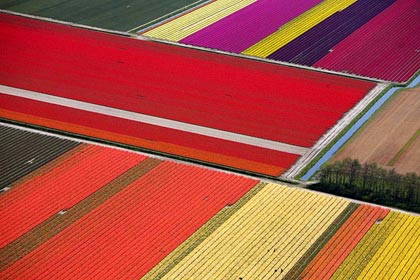
from "Dutch farmers tip-toe through the tulips as landscape is transformed into a spectacular display of colour," uncredited photo, Mail Online, 8 May, 2008 :: via FFFFOUND!
It's easy to fall into modern-mechanistic metaphors when we consider the scale and scope of industrialized agriculture, but I like how this stunning aerial view calls to mind an older cultural product: the woven tapestry.
Nate
:
excerpt Rice husk power
Rice husk power
Here's a cool-sounding example of a company developing for-profit "meso-power" stations that take local agricultural waste and use it to generate electricity for rural villages in India.
Nate
:NextBillion.net: Tell me about rice husk – what is it, how much is there, where do you find them? What do farmers do with them now?
Chip Ransler: Rice husk is the outside of a rice kernel. When you harvest rice, husk represents about 30 percent of the gross weight. As a result, husks are removed and discarded before transport. In a typical village, about 1500 tons of rice are harvested every season, yielding 500 tons of husk and 1000 tons of edible product. The farmers either burn the husk or allow it to rot in the fields.
Rice husk is cellulosic, which means it can be heated up and released for energy – the gas released is similar to methane. It also contains silica, which is released as a waste product when burned.
So, why is this interesting? If you took a map of the world’s energy poor areas and compare it to a map of rice producing areas, these two maps would look nearly identical. So we use husk to make electricity. The gas we make out of the husk is filtered, then run through a diesel-like engine to generate power.
Like I said, farmers throw away or burn rice husk – releasing methane into the atmosphere. This is an opportunity too. We’re working with the Indian government on getting our Clean Development Mechanism certification to sell carbon credits associated with our plants. And the silica – which is the other waste product – is sold to concrete manufacturers. So we take agricultural waste and turn it into electricity, minerals and carbon credits.
photo  Sorting olives
Sorting olives

"A Palestinian woman sorts olives during the harvest in a grove next to Israel's separation barrier near the West Bank village of Abu Dis, on the outskirts of Jerusalem," by Ashraf Abu Turk (AP), The Big Picture, 15 October 2008
I wish I knew more about the olive-sorting process. Perhaps the dried-out ones drift away? Or is she just rearranging the bowl's contents so she can do a visual inspection once things have settled?
Nate
:
excerpt The dignity of plants
The dignity of plants
I think this is getting at something important, though perhaps from the wrong angle. I feel like the dignity of plants (and, I think more usefully, that of landscapes and ecosystems) can only have meaning when you approach it with a view towards relationships: creation/creator, creation/cultivator. The relationship, not the plant, is what has or can be denied dignity. Two other notes: I don't think the "interference with the plant's ability to reproduce" is a great litmus test in any case, since most domesticated plants have lost the ability to make it without human help (and we with their help). And finally, fittingly, it's worth remembering that Switzerland was the setting for Mary Shelly's Frankenstein, that great and terrible tale of a creator's failure to love his creature.
Nate
:For years, Swiss scientists have blithely created genetically modified rice, corn and apples. But did they ever stop to consider just how humiliating such experiments may be to plants?
That’s a question they must now ask. Last spring, this small Alpine nation began mandating that geneticists conduct their research without trampling on a plant’s dignity.
“Unfortunately, we have to take it seriously,” Beat Keller, a molecular biologist at the University of Zurich. “It’s one more constraint on doing genetic research.”
Dr. Keller recently sought government permission to do a field trial of genetically modified wheat that has been bred to resist a fungus. He first had to debate the finer points of plant dignity with university ethicists. Then, in a written application to the government, he tried to explain why the planned trial wouldn’t “disturb the vital functions or lifestyle” of the plants. He eventually got the green light.
The rule, based on a constitutional amendment, came into being after the Swiss Parliament asked a panel of philosophers, lawyers, geneticists and theologians to establish the meaning of flora’s dignity.
“We couldn’t start laughing and tell the government we’re not going to do anything about it,” says Markus Schefer, a member of the ethics panel and a professor of law at the University of Basel. “The constitution requires it.”
In April, the team published a 22-page treatise on “the moral consideration of plants for their own sake.” It stated that vegetation has an inherent value and that it is immoral to arbitrarily harm plants by, say, “decapitation of wildflowers at the roadside without rational reason.”
On the question of genetic modification, most of the panel argued that the dignity of plants could be safeguarded “as long as their independence, i.e., reproductive ability and adaptive ability, are ensured.” In other words: It’s wrong to genetically alter a plant and render it sterile.

Aerial photo, source unknown :: via FFFFOUND!
Google Maps has both increased my appetite for aerial photography and my tolerance for less-than-perfect images. Who cares if it's a little blurred or watermarked as long as you get to see whatever patch of ground you care to look at? But comes a time when something better—like this gorgeous shot of what I presume are some farm buildings, taken at the golden-lit "magic hour" of dawn or dusk—stirs a hunger-for-the-view not so easily satisfied with satellites and databases.
Nate
:
excerpt Tree of life
Tree of life
What's interesting here—aside from the story itself, which sounds hopeful indeed—is the way the moringa tree is being passed between different (though surprisingly overlapping) cultural worlds: Africa and Asia and America, rich and poor, traditional and modern, folk and scientific. My ears prick up at the words that accompany (often in necessary quotation-marks) these handoffs: "discovered," "miracle," "awaits validation."
Nate
:As a child growing up in India, I greeted the appearance of one particular vegetable on my plate with exaggerated distaste: tender seedpods from the moringa tree, locally known as “drumsticks.” Imagine my surprise when I heard a health worker from sub-Saharan Africa describe this backyard tree as a possible solution to malnutrition in tropical countries – he called it a “miracle tree,” no less.
Ounce for ounce, says Lamine Diakite, a Red Cross official from French Guinea in West Africa, moringa leaves contain more beta carotene than carrots, more calcium than milk, more iron than spinach, more Vitamin C than oranges, and more potassium than bananas. Its protein content is comparable to that of milk and eggs, and its leaves are still available for harvest at the end of the dry season, when other food may be scarce. Malnourished children gained weight when put on a timely dietary supplement made from the leaves, Mr. Diakite says. He passed around pouches of the green, hennalike powder at a recent international summit in Boston.
Until a decade ago, moringa was not widely known in Africa. Its leaves (boiled like spinach) were an occasional vegetable. Immigrant Indians prized the long, slender seedpods (stewed or cooked like green beans) as a delicacy. “But its nutritional value, newly ‘discovered,’ has been known for a long time,” says Lowell Fuglie, an international development administrator who has been instrumental in popularizing the moringa in Africa for the past 10 years. Laboratory analysis has corroborated traditional knowledge about the plant. It now awaits further validation by western science.
excerpt The community garden
The community garden
Posting about Benched reminded me of this encouraging article by Corby Kummer about the Neustras Raíces community garden program in Holyoke, Massachusetts—a place where neighbors have taken ownership of long-term transformation.
Andy
:Even in the middle of winter, when I visited, it was apparent how meticulously the gardens are maintained—unlike many other urban gardens I know, which out of season can resemble the trash heaps they started out as. Everything looked freshly groomed: the wooden fences separating individual 15-by-20-foot plots, the gaily painted casitas, tool sheds that are “artistic statements,” Ross told me, and gathering places like stoops. Several gardens had plastic-covered hoop houses, greenhouses that in the dead of winter can get pretty grungy. I didn’t detect a rip.
“We have nine community gardens in some of the toughest neighborhoods in the city if not the country,” Ross said, “and the incidence of vandalism has been almost zero.” Joel Cortijo, a colleague along for the tour, said simply, “It’s ours.” . . .
Gardens are the heart of everything Nuestras Raíces does. Children can often be found playing in vegetable patches and in adjacent playgrounds built on land cleared of needles, broken glass, and brush that gave dealers a place to hide their drugs. Grandfathers and fathers, many of whom grew up on farms in Puerto Rico, teach schoolchildren how to grow peppers and eggplants and experiment in greenhouses on the farm with exotics like papayas and avocados, to see what they can get to grow in the New England climate. “During the summer you’ll find a dozen guys sitting on tables and benches,” Ross said, “shelling beans and telling lies about the size of their tomatoes.”
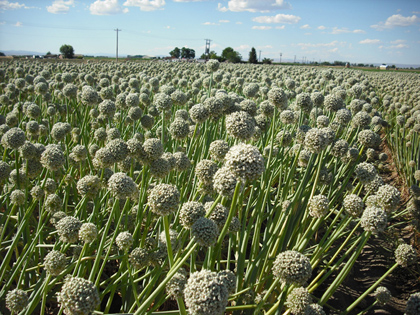
"Onion field, rural Washington," by Emily Gatch
This photo arrived in an email from a good friend who's in plant pathology grad school. I had to email her to ask what it was. Turns out it's just a field of plain old ordinary onions that've been allowed to mature and go to seed. She wrote, "Onions that have gone to seed are so cool -- you may have seen ornamental alliums around town, with big bulbous balls, often purple. A field of onion flowers looks like an outerspace commodity."
Nate
: